Rechercher dans ce blog

Wednesday, July 1, 2020

Universal Basic Income in California? Here Are the Mayors Supporting it - The New York Times

adanyabegini.blogspot.com
Credit...Jason Henry for The New York Times

Good morning.

(Here’s the sign-up, if you don’t already get California Today by email.)

First, here’s a quick update on the state’s reopening process:

If you’ve been wondering how state and local officials will try to stem the alarming spread of the coronavirus over what is certain to be a busy holiday weekend, you may get an answer today.

On Tuesday, Gov. Gavin Newsom said that the virus was still spreading in California communities at troubling rates. He said that, as a result, he expected four more counties would be added to the state’s Covid-19 watch list.

So, he said, stay tuned for announcements today about measures meant to address “concerns around the Fourth of July,” and stricter enforcement of the state’s mask mandate, including in areas where local officials have said they won’t enforce it.

You can watch Mr. Newsom’s briefings here.

[Track coronavirus cases and deaths per capita in each California county.]


Credit...Jason Henry for The New York Times

For Californians, the economic devastation wrought by the pandemic has only deepened existing inequality.

When we asked what you wanted to know about how the pandemic is reshaping life in the Golden State, Erin Durham, a former San Franciscan now living in Europe, asked about the kinds of social programs she’s seen there, or whether California might implement one that has recently gained traction: a universal basic income.

“I believe that the basic guaranteed income initiative would work very well in a rich state that relies so much on lower paid workers and that has a huge homeless problem that seems to be irresolvable,” she wrote. “It only looks like a win-win to me.”

While the idea's most high-profile booster this year was the presidential candidate Andrew Yang, a universal basic income, or guaranteed income, experiment has been underway in Stockton since early last year.

The idea is for the government to give everyone, regardless of their wealth or employment status, a certain amount of money every month — in the Stockton case, though, it is 125 residents receiving $500 of donated cash — which would remove “the stigma of traditional welfare schemes while ensuring sustenance for all,” as my colleague reported in 2018.

[Read the full story about Stockton’s first-in-the-nation program.]

Now, Stockton’s first Black mayor, and, at 29, its youngest, Michael Tubbs, is leading a push to expand the idea with a new initiative, Mayors for a Guaranteed Income. Mayors from across the country — including Eric Garcetti of Los Angeles, Aja Brown of Compton and Libby Schaaf of Oakland — have signed on.

Earlier this week, I talked with Mr. Tubbs about the effort and about Stockton right now. Here’s our conversation, lightly edited and condensed:

Tell me about how Mayors for Guaranteed Income builds on what’s already happening in Stockton.

We found that over the last 18 months, as we’ve been piloting in Stockton, so many cities have reached out, wanting to do something like this for their constituents.

Something this important and fundamental has to be at the federal level, but oftentimes, the federal government needs test cases.

Then, during Covid-19, I spent a lot of energy ensuring that the folks in our pilot would have their program be extended at least to January. We were able to do that thanks to a grant.

But then the George Floyd civil unrest happened. I reread the section of “Where Do We Go From Here?” Dr. King’s last book, about guaranteed income. I was fascinated because I realized he wrote that book in a context very similar to this one, where there was civil unrest in every city. Folks were angry and protesting the structural racism and violence in society.

And so I said, “Let me reach out to some mayors I know and see if they will join with me in creating a network, saying we need to do pilots in our cities, but we also need a federal policy that speaks to economic insecurity.” So that’s what I did.

What’s been the most surprising thing about the program?

I wish I had known just how emotional some of the stories would make me.

Stories of people who have jobs, people who, on the surface, everything looks good, but something as small as $500 has been the difference between eviction and homelessness and being housed, or being able to take time off to interview for a better job.

And a lot of them have told our researchers that this is the first time they’ve been seen. I was unprepared for the level of people struggling.

What do you see as the biggest challenge to scaling up?

The past couple months you have Covid-19, which showcased how fragile our economy is, where we literally today have essential workers who are putting their health and lives on the line, who still cannot afford rent and are still standing in food banks after work.

  • Frequently Asked Questions and Advice

    Updated June 30, 2020

    • What are the symptoms of coronavirus?

      Common symptoms include fever, a dry cough, fatigue and difficulty breathing or shortness of breath. Some of these symptoms overlap with those of the flu, making detection difficult, but runny noses and stuffy sinuses are less common. The C.D.C. has also added chills, muscle pain, sore throat, headache and a new loss of the sense of taste or smell as symptoms to look out for. Most people fall ill five to seven days after exposure, but symptoms may appear in as few as two days or as many as 14 days.

    • Is it harder to exercise while wearing a mask?

      A commentary published this month on the website of the British Journal of Sports Medicine points out that covering your face during exercise “comes with issues of potential breathing restriction and discomfort” and requires “balancing benefits versus possible adverse events.” Masks do alter exercise, says Cedric X. Bryant, the president and chief science officer of the American Council on Exercise, a nonprofit organization that funds exercise research and certifies fitness professionals. “In my personal experience,” he says, “heart rates are higher at the same relative intensity when you wear a mask.” Some people also could experience lightheadedness during familiar workouts while masked, says Len Kravitz, a professor of exercise science at the University of New Mexico.

    • I’ve heard about a treatment called dexamethasone. Does it work?

      The steroid, dexamethasone, is the first treatment shown to reduce mortality in severely ill patients, according to scientists in Britain. The drug appears to reduce inflammation caused by the immune system, protecting the tissues. In the study, dexamethasone reduced deaths of patients on ventilators by one-third, and deaths of patients on oxygen by one-fifth.

    • What is pandemic paid leave?

      The coronavirus emergency relief package gives many American workers paid leave if they need to take time off because of the virus. It gives qualified workers two weeks of paid sick leave if they are ill, quarantined or seeking diagnosis or preventive care for coronavirus, or if they are caring for sick family members. It gives 12 weeks of paid leave to people caring for children whose schools are closed or whose child care provider is unavailable because of the coronavirus. It is the first time the United States has had widespread federally mandated paid leave, and includes people who don’t typically get such benefits, like part-time and gig economy workers. But the measure excludes at least half of private-sector workers, including those at the country’s largest employers, and gives small employers significant leeway to deny leave.

    • Does asymptomatic transmission of Covid-19 happen?

      So far, the evidence seems to show it does. A widely cited paper published in April suggests that people are most infectious about two days before the onset of coronavirus symptoms and estimated that 44 percent of new infections were a result of transmission from people who were not yet showing symptoms. Recently, a top expert at the World Health Organization stated that transmission of the coronavirus by people who did not have symptoms was “very rare,” but she later walked back that statement.

    • What’s the risk of catching coronavirus from a surface?

      Touching contaminated objects and then infecting ourselves with the germs is not typically how the virus spreads. But it can happen. A number of studies of flu, rhinovirus, coronavirus and other microbes have shown that respiratory illnesses, including the new coronavirus, can spread by touching contaminated surfaces, particularly in places like day care centers, offices and hospitals. But a long chain of events has to happen for the disease to spread that way. The best way to protect yourself from coronavirus — whether it’s surface transmission or close human contact — is still social distancing, washing your hands, not touching your face and wearing masks.

    • How does blood type influence coronavirus?

      A study by European scientists is the first to document a strong statistical link between genetic variations and Covid-19, the illness caused by the coronavirus. Having Type A blood was linked to a 50 percent increase in the likelihood that a patient would need to get oxygen or to go on a ventilator, according to the new study.

    • How many people have lost their jobs due to coronavirus in the U.S.?

      The unemployment rate fell to 13.3 percent in May, the Labor Department said on June 5, an unexpected improvement in the nation’s job market as hiring rebounded faster than economists expected. Economists had forecast the unemployment rate to increase to as much as 20 percent, after it hit 14.7 percent in April, which was the highest since the government began keeping official statistics after World War II. But the unemployment rate dipped instead, with employers adding 2.5 million jobs, after more than 20 million jobs were lost in April.

    • How can I protect myself while flying?

      If air travel is unavoidable, there are some steps you can take to protect yourself. Most important: Wash your hands often, and stop touching your face. If possible, choose a window seat. A study from Emory University found that during flu season, the safest place to sit on a plane is by a window, as people sitting in window seats had less contact with potentially sick people. Disinfect hard surfaces. When you get to your seat and your hands are clean, use disinfecting wipes to clean the hard surfaces at your seat like the head and arm rest, the seatbelt buckle, the remote, screen, seat back pocket and the tray table. If the seat is hard and nonporous or leather or pleather, you can wipe that down, too. (Using wipes on upholstered seats could lead to a wet seat and spreading of germs rather than killing them.)

    • What should I do if I feel sick?

      If you’ve been exposed to the coronavirus or think you have, and have a fever or symptoms like a cough or difficulty breathing, call a doctor. They should give you advice on whether you should be tested, how to get tested, and how to seek medical treatment without potentially infecting or exposing others.


You have civil unrest with the George Floyd murder, and people are demanding a change.

I think the hardest part is probably mustering the political will, but if we can’t summon the political will now, at the time when we’re entering into a Great Depression, at a time where we’re at levels of inequality not seen since the Gilded Age, it’s a time of civil unrest.

If we can’t muster the political will to act now, then we have a deeper problem of values and ability to act in our society.

I know that the George Floyd protests were tricky for progressive mayors and you recently talked to my colleagues about navigating that. But since then, calls have turned more explicitly to defunding or dismantling police departments. Do you support defunding the Stockton Police Department, or is that something you’re looking into?

We know that crime correlates with poverty, and things like mental illness can be exacerbated by poverty. So one way we get to a society where we don’t need as many officers is to abolish poverty. I think guaranteed income is a step in that direction.

Ideally, we’d love to live in a world without crime, but as long as there’s crime there will be a need for officers.

In Stockton’s context, because of the bankruptcy, we decimated our police force by about 30 percent about a decade ago. And twice in the last decade our citizens have voted to tax themselves more to pay for officers.

What we’ve been doing in Stockton is really looking at the role of police. Like other cities, we’ll be doing an analysis of 911 calls to see which are calls that don’t need an officer.

What do you think is the biggest misconception about guaranteed income programs?

The biggest misconception I hear is that it rewards people for not working. That’s such a racist trope and it’s not true. The second big misconception I’ve heard is that we can’t afford it. But there are all these proposals now to do that.

So the question is: Do we trust our neighbors to spend money well? I would argue we should and we have to, given this crisis we face.


California Today goes live at 6:30 a.m. Pacific time weekdays. Tell us what you want to see: CAtoday@nytimes.com. Were you forwarded this email? Sign up for California Today here and read every edition online here.

Jill Cowan grew up in Orange County, went to school at U.C. Berkeley and has reported all over the state, including the Bay Area, Bakersfield and Los Angeles — but she always wants to see more. Follow along here or on Twitter.

California Today is edited by Julie Bloom, who grew up in Los Angeles and graduated from U.C. Berkeley.

Let's block ads! (Why?)


"here" - Google News
July 01, 2020 at 09:01PM
https://ift.tt/2VBVQlE

Universal Basic Income in California? Here Are the Mayors Supporting it - The New York Times
"here" - Google News
https://ift.tt/2z7PfXP
https://ift.tt/2Yv8ZPx

We Built a Diverse Academic Department in 5 Years. Here's How. - Harvard Business Review

adanyabegini.blogspot.com

Executive Summary

Washington University in St. Louis has one of the more racially diverse sociology departments in academia today. This is no accident. It was the result of intentional, consistent efforts from multiple stakeholders to create a department that would be both racially diverse and committed to excellence. If organizations that want to become truly diverse, they can learn from the three key elements of Wash U’s success: firm, explicit support and resources from leadership; an intentional focus on racial diversity in hiring and advancement; and creating a culture that recognizes and responds to the realities Black workers face.

Hill Street Studios/Getty Images

I work in the sociology department at Washington University in St. Louis. Our department has several interesting distinctions — it was formed in 2015, making it one of the newest sociology departments in the country. It came into being after this region was rocked by protests following a grand jury’s refusal to indict Officer Darren Wilson for killing Michael Brown in nearby Ferguson.

But perhaps most notably, we comprise one of the more racially diverse departments in academia today. This wasn’t an accident. It was the result of intentional, consistent efforts from multiple stakeholders to create a department that would be both racially diverse and committed to excellence.

In just five years, our department has grown to 13 full-time faculty, nearly half of whom identify as people of color. Not only that, of the eight senior professors in my department, half of us are people of color. Three of these senior faculty are women, and three identify as Black. This is the kind of racial diversity that many departments in academia and other organizations say is impossible to create, claiming that there’s too leaky a pipeline, or that it’s too difficult to find strong candidates. Our experience building Washington University’s sociology department shows that these results are certainly possible. Here’s a glimpse at our playbook.

When university leadership decided to launch a sociology department, the administrators, advisory committees, and faculty leaders involved with this effort asserted early on that it would not be enough for the faculty to excel in research and teaching. These leaders were emphatic that this department needed to be racially diverse as well. They stressed that there doesn’t have to be a contradiction between valuing diversity and hiring the best person for the job — indeed, those two imperatives are complementary more often than some might think.

Following a national search for faculty who could become founding members of the new sociology department, I was hired in 2015 with two other colleagues who are white men. Early on in our first few months on the job, my coworkers and I explicitly prioritized building a racially diverse department. During that first year, I vividly remember sitting in department meetings as the lone woman and person of color and thinking, “This is the last year that department meetings look like this.” Fortunately, my other departmental colleagues thought — and openly said — the same thing. This meant that there was collective, shared support for the importance of building a racially diverse faculty. It wasn’t up to one person to raise and continue pressing this issue, a phenomenon that often occurs when women or racial minority men are in the minority at work. We all agreed that this mattered and that we wanted our hiring decisions to reflect this commitment.

This early support for a racially diverse department was absolutely crucial. It set the tone for our department and created a ripple effect on future hiring cycles. But it also highlights that creating more racial diversity is much easier when multiple voices in leadership agree to make it a priority. I expect that in settings where departmental and managerial leadership does not prioritize or actively work to create racial diversity, it will be much harder to make changes.

When it came time to begin our hiring cycle for the first round of assistant professors to interview for jobs, we made sure to advertise our open position in a broad range of locations. Since we knew that relying on social networks often excludes candidates of color, we did not want to rely primarily on our alma maters or other networks where we would be likely to net a predominantly white applicant pool. Instead, we relied on professional associations that primarily included sociologists of color. We contacted colleagues to let them know that we were hiring and particularly wanted to consider applicants from underrepresented minority groups. We looked for promising candidates of color, contacted them, and encouraged them to apply. In short, we didn’t just wait for applicants of color to come to us. We made it a point to be proactive in our efforts to create a diverse candidate pool. And we continued these efforts throughout the hiring process, checking ourselves at every step of the way to make sure that each time we further narrowed our list, we still had a diverse slate of candidates.

This is another stage where support from university leadership was critical. Higher level administrators reiterated that they welcomed and encouraged our efforts to build a racially diverse department. More importantly, they backed this up with action. They provided financial resources (available tenure track lines, funding, and competitive retention packages) that allowed us to attract, hire, and keep faculty of color. It matters knowing that the higher-ups value racial diversity.

These are important steps to take when it comes to hiring, but that’s only part of the battle when it comes to racial diversity in the workplace. It’s also very important for people of color to be included, visible, heard, and represented in the everyday life of the department. This is where organizational culture matters a lot. As sociologists who study race and the workplace have shown, if a company hires one or two workers of color who then have to navigate a consistently hostile and unwelcoming space, that company probably isn’t going to keep those workers for long. Equally important to hiring is creating an organizational culture that is attuned to racial dynamics and actively encourages the participation, visibility, and authentic voices of people of color.

In our department, for example, we simply refuse to have a “colorblind” organizational culture where discussion of and attention to racial issues is taboo or discouraged. In our teaching and research, we include the voices and experiences of people of color. From classes on “Race, Ethnicity, and Migration” and “The Roots of Ferguson,” to social theory seminars that assign the work of overlooked Black sociologists like W.E.B. DuBois and Anna Julia Cooper, to research on how factors such as incarceration and policing contribute to racial health disparities, acknowledging race is a critical part of our departmental mission. Importantly, this focus doesn’t mean that everyone in the department focuses on these issues. Some of my colleagues do not make race a central focus of their research or teaching. But we see it as an imperative to nurture a department culture that makes room for all voices to be heard, rather than sidelining or downplaying racial issues in our teaching or scholarship.

Our “extracurricular” activities carry this theme of color-consciousness as well. One year, we hosted a screening and discussion of the sociological themes present in the film Get Out. The following year, we did the same for the film BlacKkKlansman. Before the coronavirus upended our spring semester, we’d discussed continuing this screening and discussion trend with the film Sorry to Bother You. These events allow us to engage in optional activities in ways that still fulfill our departmental mission while avoiding a colorblind culture where conversations around race are discouraged.

As the country is rocked by protests drawing attention to the ongoing exploitation, harassment, and abuse of Black Americans, many companies are signaling their support for the Black Lives Matter movement and siding with the protesters. Yet most of these same companies have for years failed to create more racial diversity among the top ranks of their own organizations. This has happened in America before. In the wake of civil rights era reforms, many companies established urban affairs or community relations departments which were headed by Black managers who then found few opportunities for upward mobility within their organizations and little leverage to make comprehensive change.

This strategy didn’t reduce workplace inequities, and it should not be the model companies follow in 2020. It’s past time for a commitment to creating more racially diverse workplaces through actions, and not just words. The takeaway from my experience at Wash U is that companies can do that with some core factors in place: firm, explicit support and resources from leadership; an intentional focus on racial diversity in hiring and advancement; and creating a culture that recognizes and responds to the realities Black workers face.

Let's block ads! (Why?)


"here" - Google News
July 01, 2020 at 07:10PM
https://ift.tt/2NKJmUr

We Built a Diverse Academic Department in 5 Years. Here's How. - Harvard Business Review
"here" - Google News
https://ift.tt/2z7PfXP
https://ift.tt/2Yv8ZPx

What Will School Look Like This Fall In Illinois? - WBEZ

With just two months before the school year starts again, Chicago-area public and private school officials are figuring out back-to-school plans for a year in which COVID-19 will undoubtedly still be with us.

With Illinois now in Phase 4 of its reopening plan, Gov. JB Pritzker last week gave schools the go-ahead to reopen this fall under certain conditions. New guidelines include masks, no more than 50 students in one space and an increase in schoolwide cleanings and disinfection, as well as symptom checks.

Beyond that, details on how to provide instruction will be decided by each school and district. For now, there appear to be two main options on the table: full-day in-person instruction or a combination of in-person and remote learning.

Close to normal?

The Archdiocese of Chicago has already said it wants to move ahead with a school year as close to normal as possible. The archdiocese has more than 200 Catholic schools and more than 70,000 students in Cook and Lake counties.

“At this point, it is our intent to enable all of our students to return to school in the fall and to be there for full school days,” said Jim Rigg, superintendent of Catholic schools for the Archdiocese of Chicago.

Rigg said his team conducted 15 listening sessions with more than 130 parents. They are still working out specifics, but their plan includes looking after teachers with health concerns and increased communication with teachers and parents.

Rigg also expects additional spending, especially on things like cleaning products and personal protective equipment.

To cover the new costs, Rigg anticipates getting federal coronavirus relief funding and maintaining strong fundraising efforts, despite the challenges imposed by the pandemic and ongoing financial challenges at some schools.

A hybrid model

Many other schools, like Roycemore, a small independent school in Evanston, are looking at a hybrid model that combines in-person and remote learning. They're also considering offering online only or in-person only options based on parent preference.

Roycemore has 217 students from preschool to 12th grade. Aside from ramping up school cleanliness, school officials say students in earlier grades will be in separate parts of the schools, desks will be placed six feet apart, windows will be wide open if weather permits and students will have camp chairs if class is moved outdoors. Students also will have lunch boxes and will be expected to eat at their desks instead of the cafeteria.

The school will also offer remote learning if needed.

“We are providing these multiple options and this flexible opportunity for families, recognizing that every family has different needs,” said Adrianne Finley Odell, the head of Roycemore School. “Some of them may have a grandparent living at home.”

She’s also anticipating huge investments, especially in cleaning.

“It's thousands of dollars that we are going to have to spend in additional expenses for disinfection and cleaning and even protection [equipment],” she said.

Chicago’s plan due out soon

In Chicago Public Schools, a district with more than 600 schools, it’s still unclear what the next school year will look like. The district is surveying parents about their preferences now. CPS CEO Janice Jackson last week said a more concrete plan will come out in a few weeks.

“It will be a draft and there will be a couple of weeks for parents and community members to weigh in,” Jackson said. “We will also instruct schools to put together their own specific plans that they are going to be sharing with their local school councils.”

At Burroughs Elementary on the Southwest Side, principal Richard Morris already has recommendations. For one, he said, the school buildings have to be clean at all times. School cleanliness is something CPS has had big problems with in the past.

Morris is aware of the difficult task ahead. “Every building is different, every school has different populations. So it will be really hard to manage it from the top,” he said.

At Burroughs, he said teachers want in-person instruction, but they also want to feel safe. He likes the idea of a staggered schedule with some in-school and remote instruction. That model could work, he said, as long as students have guaranteed access to high-speed internet, something that was a challenge when school buildings closed in March.

“If we come back in the fall after two more months and we still have kids who can’t connect anywhere, that to me will be a big failure,” Morris said.

Mayor Lori Lightfoot recently acknowledged many students lagged behind academically during the COVID-19 school shutdown because they couldn’t connect. This came despite the school district distributing more than 100,000 computers. She and Jackson recently announced plans to offer free high-speed internet to more than 100,000 low-income CPS students for four years starting this summer using public and private dollars.

“We now know, as we should have known prior to this, that having a device and access to broadband is as essential as we thought textbooks were in the 1980s,” Jackson said.

State officials say that’s a key component because moving forward, if infections rise, all schools will need to be nimble and transition back quickly to full-time remote learning.

Adriana Cardona-Maguigad covers education for WBEZ. Follow her on Twitter @WBEZeducation and @AdrianaCardMag.

Let's block ads! (Why?)


"like this" - Google News
July 01, 2020 at 06:00PM
https://ift.tt/2Vy2BFa

What Will School Look Like This Fall In Illinois? - WBEZ
"like this" - Google News
https://ift.tt/2MWhj4t
Shoes Man Tutorial
Pos News Update
Meme Update
Korean Entertainment News
Japan News Update

Did Floyd Protests Lead to a Virus Surge? Here’s What We Know - The New York Times

adanyabegini.blogspot.com

For more than two months, the authorities had been urging New Yorkers to stay indoors and keep their distance from others. But after the police killed George Floyd in Minneapolis, tens of thousands of New Yorkers poured into the streets, day and night, to protest police brutality and racism.

Epidemiologists braced for a surge of new coronavirus cases. But it has not come yet.

On May 27, the day before the protests began in New York City, some 754 Covid-19 cases were diagnosed, according to the city’s Department of Health. That was the last time the city recorded more than 700 cases on a single day.

By the end of the first week of protests, the city was recording slightly more than 500 cases a day. By the end of the second week of protests, the case counts were in the low 400s or high 300s a day. They’ve continued to drop slightly. The last time New York City recorded more than 300 cases was on June 22.

“We’ve been looking very closely at the number of positive cases every day to see if there is an uptick in the context of the protests,” Ted Long, executive director of the city’s contact tracing program, said. “We have not seen that.”

In interviews, several epidemiologists expressed either surprise or relief, and offered theories for what occurred. This is what we know:

The lockdown enacted in March worked. By the end of May, when the protests began, the virus was not as prevalent in New York as it had been when the lockdown began.

“It seems we in New York City did achieve a substantial decrease in the number of cases so that made the odds of encountering a case of Covid-19 in these protests quite low,” said Wafaa El-Sadr, an epidemiology professor at Columbia University.

Exactly how low is tough to gauge. Throughout June, somewhere between 10,000 and 35,000 New Yorkers per day were tested. The percentage of coronavirus tests in New York City consistently turning up positive declined in June, from about 3 percent at the start to 2 percent. But New York City has released little specific information about current hot spots or clusters, or current infection rates among different age groups.

Some cities and states have made a point of testing demonstrators and released their findings.

Credit...Byron Smith for The New York Times

In Minnesota, an initiative that targeted demonstrators found that 1.5 percent of them tested positive. In Massachusetts, fewer than 3 percent of protesters did. A positive test does not necessarily mean a person is likely to still be contagious; people can continue to test positive for weeks after becoming ill and starting to recover.

In New York, Gov. Andrew M. Cuomo pledged in early June to dedicate 15 testing sites in the city exclusively to people who attended protests. But a state Health Department spokesman said that data is not yet available.

Kitaw Demissie, an epidemiologist and dean of SUNY Downstate School of Public Health in Brooklyn, said it was possible that in areas with accelerating outbreaks — such as some southern and western states — the mass demonstrations could well play a role in the spread of the virus.

Conditions at the demonstrations may not have been conducive for transmission, mainly because the protests occurred outdoors, epidemiologists said.

The virus spreads far more easily indoors than outdoors, and close contact indoors is believed to be the main driver of transmission, epidemiologists say. One study based on a review of 110 cases in Japan found that the odds of transmission were 18.7 times higher in closed environments — everything from fitness studios to tents — than in open-air environments. Another study involving a review of thousands of cases in China found only a single instance of outdoor transmission.

In Minnesota, where Mr. Floyd was killed, cases among young adults climbed substantially over June. But officials said that gatherings in re-opened bars were partly to blame.

The virus is thought to be spread primarily through the virus-laden droplets emitted when a contagious person coughs, sneezes or talks. When outdoors, this virus-laden air is more quickly diluted and carried away than it would be in a poorly ventilated room. Because a certain quantity of virus is needed for an infectious dose, the dilution can make a significant difference, epidemiologists say.

Another potential factor: Demonstrators were often on the move, marching at a brisk pace. That may have promoted dilution and also spaced people out from each other.

Credit...Simbarashe Cha for The New York Times

“This doesn’t say that being in a crowd is not risky,” said Howard Markel, a physician and historian of medicine at the University of Michigan who has written on past epidemics. He said that protesters in New York may have just been “incredibly lucky.”

He noted that outdoor crowds can accelerate the spread of respiratory viruses — most notoriously during a war bond parade in Philadelphia during the 1918 influenza pandemic.

New York City’s Health Department had gone so far as to urge protesters not to chant or yell — which can increase the likelihood of transmission — but to instead carry signs and consider bringing a drum.

But while that bit of advice went largely unheeded, most protesters adhered to another: Wear a mask.

Carlos Polanco, 21, from Brooklyn, who protested for 22 or 23 days straight, often out front at protests with a bullhorn, said that organizers made a point of bringing extra masks and distributing them to demonstrators. Mr. Polanco, a rising senior at Dartmouth College, said that he tried to wear a mask except when he was delivering a speech or leading chants — during which time he tried to keep his six feet of distance from others, he said.

And many protesters complained when police officers at protests did not wear masks.

Some scientists say it’s still too early to tell how much transmission occurred at the demonstrations in New York. One reason is that many protesters were young adults — a demographic in whom severe cases and hospitalizations are less common. As a result, a rise in cases that started within this demographic might remain undetected by public health officials for longer.

“We don’t know the impact. We’ll see that in the next two weeks,” Florian Krammer, a virologist at the Icahn School of Medicine at Mount Sinai, said in an interview last week.

Moreover, city officials have instructed contact tracers not to ask new Covid-19 patients if they attended protests, according to a report in The City, a nonprofit news organization.

And the protests continue. Hundreds gathered at City Hall Park over the past week, to demand deep cuts to the New York Police Department budget. Some protesters are camping out in sleeping bags or under tarps. The gathering is drawing some comparisons to the Occupy Wall Street encampment at nearby Zuccotti Park in 2011. Rarely remembered, a vicious cough, called “Zuccotti lung,” circulated around that encampment.

So far there has been no clear increase in patients in emergency rooms complaining of pneumonia or flu-like symptoms — a metric the city’s Health Department tracks as an early warning system for Covid-19 transmission.

But public health experts cautioned against drawing too much reassurance from New York’s experience. “Like most every other aspect of this pandemic the most predictable thing is the unpredictability,” said Professor Markel, the historian and physician from the University of Michigan.

Let's block ads! (Why?)


"here" - Google News
July 01, 2020 at 07:03PM
https://ift.tt/3eKf009

Did Floyd Protests Lead to a Virus Surge? Here’s What We Know - The New York Times
"here" - Google News
https://ift.tt/2z7PfXP
https://ift.tt/2Yv8ZPx

Blackpink’s 'How You Like That' Collects Multiple Guinness World Records - Billboard

Blackpink’s historic week has been rewarded with a swag of Guinness World Records.

The south Korean girl group’s music video for "How You Like That" earned 86.3 million views on its arrival June 26, enough to set records for most viewed YouTube video in 24 hours, most viewed music video on YouTube in 24 hours, and most viewed YouTube music video in 24 hours by a K-pop group.

It’s not such a great week for compatriots BTS, who were the previous record holders in those categories with the video for "Boy With Luv" featuring singer Halsey, which dropped in April 2019. "Boy With Luv" is now scrubbed from the record books.

Jisoo, Jennie, Rose and Lisa aren’t done with busting records. The live premiere of '"How You Like That" reached 1.66 million peak concurrent viewers on the streaming video platform, setting new records for most viewers for the premiere of a video on YouTube, and most viewers for the premiere of a music video on YouTube.

They’re already the holders of records for most followed female group on Spotify and music group with the most subscribers on YouTube, eclipsing One Direction, according to Guinness World Records.

Written by Teddy and Danny Chung, "How You Like That" ends Blackpink's one-year musical hiatus since 2019's Kill This Love EP, which reached No. 24 on the Billboard 200.

“How You Like That" is expected to appear on Blackpink's forthcoming debut studio album.

In just five days, the music video has powered to more than 170 million views.  Watch below.

Let's block ads! (Why?)


"like this" - Google News
July 01, 2020 at 12:51PM
https://ift.tt/2ZjGWkQ

Blackpink’s 'How You Like That' Collects Multiple Guinness World Records - Billboard
"like this" - Google News
https://ift.tt/2MWhj4t
Shoes Man Tutorial
Pos News Update
Meme Update
Korean Entertainment News
Japan News Update

NAFTA is officially gone. Here's what has and hasn't changed - CNN

adanyabegini.blogspot.com
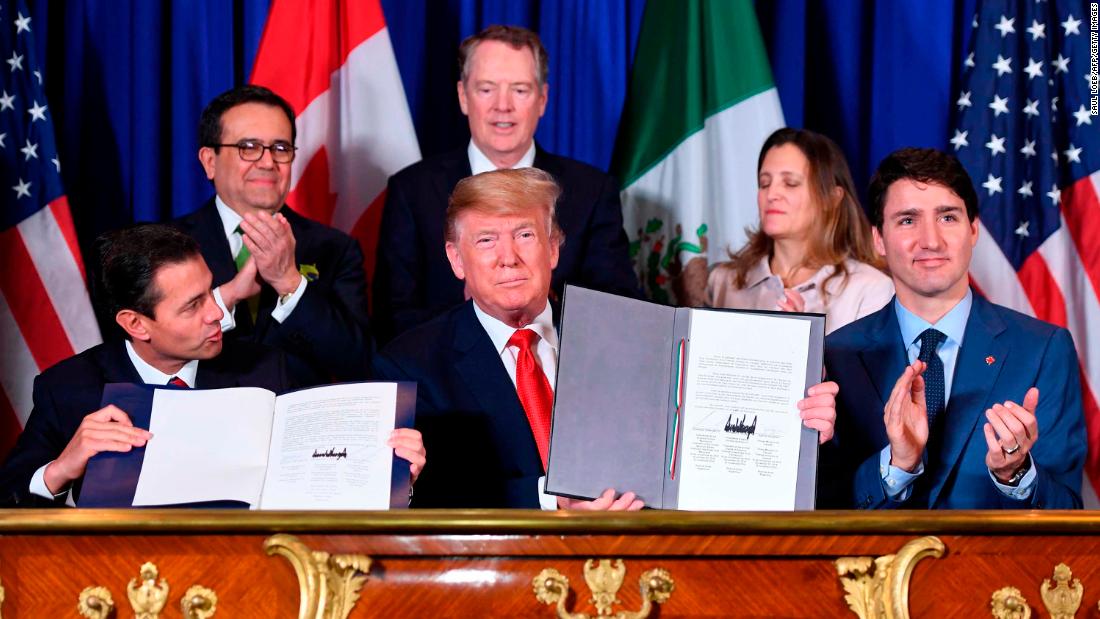
The new agreement was signed by Trump and his Mexican and Canadian counterparts in 2018 and approved by Congress earlier this year after Democrats added stronger labor rules.
It was touted by the President as a major political win ahead of his reelection campaign but has since been overshadowed by the coronavirus pandemic and other crises.
Much of USMCA simply updates the 25-year-old agreement it's replacing. It's expected to create 176,000 jobs after six years and increase US GDP by 0.35%, according to a report released last year -- long before the pandemic -- by the US International Trade Commission, a federal government agency. By comparison, the United States added more than 152,000 jobs in January 2020 alone.
But the deal provides certainty for business groups and farmers who feared Trump would rip up NAFTA without having a new deal in place, a move he threatened several times.
The USMCA stands in contrast to Trump's efforts to renegotiate trade terms with China. After more than a year of negotiations, a preliminary agreement signed in January falls short of resolving major issues with intellectual property theft and forced technology transfers. It leaves tariffs on billions of dollars of goods in place and it's unclear whether China will keep its promise to more than double its purchases from American farmers.
Trump has opted for bilateral deals and inked new agreements with South Korea and Japan. He pulled the United States out of the 12-country Trans-Pacific Partnership, known as TPP, that was negotiated by the Obama Administration.
Here are some of the key changes in the USMCA:

Auto manufacturing boost

The USMCA creates a new incentive to build cars and trucks in North America. It requires 75% of a vehicle's parts to be made in one of the three countries -- up from the current 62.5% rule -- in order to remain free from tariffs when moving between the three signatory countries.
It also requires more vehicle parts to be made by workers earning at least $16 an hour, which may provide a boost to manufacturing in the United States, where wages are higher than in Mexico.
The International Trade Commission report found that these changes would add 28,000 jobs in the industry over six years, while also leading to a small increase in the price of vehicles that consumers pay. Though, a Trump administration report was more positive, projecting that the deal would create 76,000 auto jobs over five years.

Labor laws strengthened in Mexico

Manufacturing workers have long blamed NAFTA for sending jobs to Mexico, where wages are lower, and it was a priority for Democrats that the USMCA strengthen the enforcement of labor rules, creating a more level playing field for American workers.
Democrats struck a deal with the Trump administration to strengthen the enforcement language in the deal. The changes were able to win the backing of the AFL-CIO, the largest federation of unions in the United States.
The deal provides for an interagency committee that will monitor Mexico's labor reform implementation and compliance with labor obligations. It also, for the first time in any US trade agreement, allows for "rapid response" panels to review whether specific facilities are violating workers' rights and to levy duties or penalties on products made at those facilities.

US dairy farmers get more market access

The original NAFTA eliminated tariffs on most agricultural products traded among the three countries. Canada and Mexico are already the two biggest export markets for US farmers and ranchers.
The USMCA will keep those tariffs at zero, while further opening up the Canadian market to US dairy, poultry and eggs. In return, the United States will allow more Canadian dairy, peanuts and peanut products, as well as a limited amount of sugar, to cross the border.

Updating NAFTA for the digital era

The USMCA includes sweeping new benefits for the technology sector, in a chapter on digital trade that wasn't a part of the original NAFTA. The new provisions aren't expected to directly create new jobs but could provide a boost to US businesses in other ways.
For example, the new trade deal prohibits Canada and Mexico from forcing US companies to store their data on in-country servers. It also ensures that US companies cannot be sued in Canada and Mexico for much of the content appearing on their platforms.

Environmental protections

The agreement provides $600 million to address environmental problems in the region -- like sewage spillovers from Tijuana that impact San Diego -- and makes regulations easier to enforce by doing away with a requirement to prove a violation affects trade.
While the new enforcement measures pleased most Democrats, they didn't go far enough to get environmental groups like the Sierra Club to support the agreement.

Let's block ads! (Why?)


"here" - Google News
July 01, 2020 at 11:14AM
https://ift.tt/2VAQUNP

NAFTA is officially gone. Here's what has and hasn't changed - CNN
"here" - Google News
https://ift.tt/2z7PfXP
https://ift.tt/2Yv8ZPx

Hong Kong's national security law is finally here, and it could change the city forever - CNN

adanyabegini.blogspot.com
It was drafted almost entirely in secret, via closed-door meetings in Beijing that even Hong Kong's leader, Carrie Lam, was not a part of. Even hours after its reported passage by China's National People's Congress Tuesday, all but a tiny handful of Hong Kongers still had no idea what the law contained.
Promulgated in Hong Kong late Tuesday night, bypassing the local legislature, the law criminalizes "acts of secession, subversion of state power, terrorist activities, and collusion with foreign or external forces to endanger national security."
While officials had earlier suggested penalties under the law would be softer than they are in China, the maximum sentence given for each of those four main crimes -- secession, subversion, terrorism, and collusion with foreign forces -- is life imprisonment.
Right to a trial by jury can be suspended in certain circumstances, cases can be heard in secret, and foreign residents in Hong Kong can be expelled if suspected of violating the law, regardless of conviction. The national security law trumps any existing Hong Kong laws, should there be a conflict.
The law also extends Beijing's direct control over the city, establishing a new committee for national security that will include a Beijing-appointed adviser, and an "Office for Safeguarding National Security," directly under the Beijing government, which has broad powers to prosecute Hong Kongers deemed to have committed particularly egregious offenses.
Hong Kong and Beijing officials have argued the law is necessary and overdue, and promised it will only affect a tiny minority of Hong Kongers, while returning "stability and prosperity" to the city.
"The national security law is a crucial step to ending chaos and violence that has occurred over the past few months," Lam, the city's chief executive, said Wednesday. "It's a law that has been introduced to keep Hong Kong safe. The legislation is lawful, constitutional and reasonable."
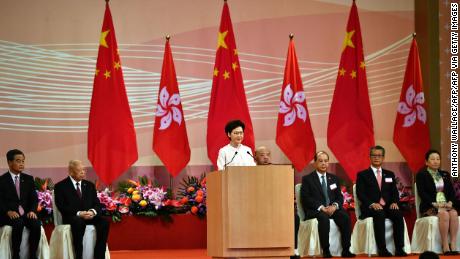
Hong Kong's Chief Executive Carrie Lam (C) speaks to guests following a flag-raising ceremony to mark China's National Day celebrations early morning in Hong Kong on July 1, 2020.

Chilling effect

Before it was even in force, the law had begun to have a chilling effect, with multiple political parties disbanding, shops removing anti-government paraphenalia, and people deleting social media accounts and old posts.
That will likely accelerate, as the offenses under the law are broad and far-reaching, with no certainty of just what actions will be deemed illegal until prosecutions are brought.
For instance, the offense of inciting, assisting or abetting secession could cover most statements related to Hong Kong independence. At recent rallies, protesters could regularly be heard chanting this was "the only way out," and waving flags promoting separatism. The minimum punishment for such crimes is five-years in prison.
In a meeting Tuesday of senior police commanders, they were told that anyone seen waving a pro-independence flag or chanting in support of independence must be arrested, a police source told CNN. In addition, the source said anybody searched and found to have independence flags in their possession will be arrested.
Subversion and terrorism are also defined particularly widely, with the latter including "dangerous activities which seriously jeopardize public health, safety or security" for the purpose of "intimidating the public in order to pursue political agenda."
If applied broadly, this could reclassify anti-government protests like the city saw last year -- which often turned violent, with clashes between protesters and police, and vandalism of public property -- as terrorism, exactly how the protests were often described in Chinese state media.
In particular, the law criminalizes the "sabotage of means of transport (and) transport facilities," or the "serious interruption or sabotage of electronic control systems" relating to transport, which could be interpreted to include vandalizing subway stations or blocking roads and buses.
The maximum punishment for serious terrorist offenses is life in prison, with a minimum sentence of 10 years. Those found guilty of related, less serious offenses can face a minimum of five years in prison.

Foreigners threatened

While the greatest impact of the law will be on Hong Kongers, it also includes multiple provisions that could affect how foreign entities, in particular media and NGOs, operate in the city.
The law states that anyone who "directly or indirectly receives instructions, control, funding or other kinds of support from a foreign country or an institution, organization or individual" could be guilty of an offense if they are pursuing certain actions deemed hostile to national security.
Those include lobbying for sanctions against Hong Kong or Chinese officials -- such as those recently imposed by Washington over this very legislation -- "undermining" elections in Hong Kong, "seriously disrupting the formulation and implementation of laws or policies" in the city, or "provoking by unlawful means hatred among Hong Kong residents towards the Central People's Government."
In China, people have been prosecuted for leaking "state secrets" to overseas media, governments and organizations, something the new Hong Kong law also criminalizes, potentially making it far harder for foreign journalists and NGOs to operate in the city.
One of the duties of the Office for Safeguarding National Security, which reports directly to Beijing, will also be the "management of (the) organs of foreign countries and international organizations in (Hong Kong), as well as non-governmental organisations and news agencies of foreign countries."
At present, Hong Kong has a generous visa policy for journalists, who are classed as regular foreign workers and not subject to the more strict regulation seen in China. It is also easy for NGOs to operate in Hong Kong, with human rights organizations, labor groups, and press freedom groups that struggle to operate in China using the city as a base.
Non-permanent residents in Hong Kong can be expelled from the city, regardless of whether they are convicted, if suspected of contravening the law.
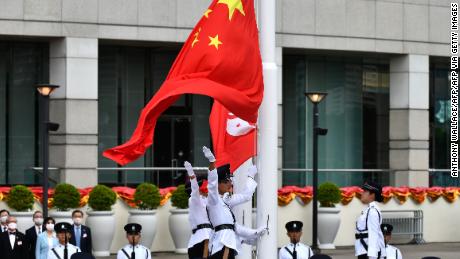
The Chinese (front) and Hong Kong flags are released during a flag-raising ceremony to mark China's National Day celebrations early morning in Hong Kong on July 1, 2020.

Judicial changes

One of the biggest controversies leading up to the passage of the law was the creation of a new panel of judges dedicated to national security cases, who will be appointed by the Chief Executive directly.
Legal analysts have warned that this could undermine judicial independence, as it enables the government to pick judges that are potentially sympathetic to particular issues.
"A person shall not be designated as a judge to adjudicate a case concerning offense endangering national security if he or she has made any statement or behaved in any manner endangering national security," the law states.
It adds that jury trials can be suspended when deemed necessary, with cases instead heard by a panel of judges.
Beyond this, certain cases can also be handed directly over to the Chinese authorities for prosecution, with the Office for Safeguarding National Security taking the lead, applying Chinese law and legal standards.
The office "shall initiate investigation into the case, the Supreme People's Procuratorate shall designate a prosecuting body to prosecute it, and the Supreme People's Court shall designate a court to adjudicate it," the law states.
When exercising this power, members of the Office "shall not be subject to the jurisdiction of the Hong Kong Special Administrative Region," and police in the city are obliged to assist in their duties and prevent anyone obstructing them.
It is unclear whether such cases will be transferred to the mainland, or if they will be processed in Hong Kong by Chinese prosecutors. The suggestion of extradition to China is what kicked off last year's massive anti-government protests.
China has a notoriously high conviction rate, especially in national security cases, and is regularly criticized for politicized prosecutions in which defendants are denied access to lawyers.

What comes next?

For weeks now, Hong Kong officials and the central government in Beijing have been reassuring members of the public that the law will be applied selectively, and only affect a tiny number of people.
Following its passage Tuesday, a Hong Kong government spokesman reiterated that the law "targets an extremely small minority of offenders while the life and property as well as various legitimate basic rights and freedoms enjoyed by the overwhelming majority of citizens will be protected."
"There is nothing for Hong Kong citizens to worry about in exercising these legitimate rights," he added.
Whether this is true remains to be seen, and may not be known for months, until the first prosecutions under the law are brought. But the chilling effect already seen this week suggests the repercussions of the law will ripple out well beyond individual cases.
Hong Kong has long been known as a "city of protest," with a vibrant opposition movement, unshackled media and dynamic public discourse. The national security law would appear to take aim at all of this, and could reshape the city forever.

Let's block ads! (Why?)


"here" - Google News
July 01, 2020 at 11:54AM
https://ift.tt/2AgST2i

Hong Kong's national security law is finally here, and it could change the city forever - CNN
"here" - Google News
https://ift.tt/2z7PfXP
https://ift.tt/2Yv8ZPx
Search

Featured Post

'Kind of the first time we've had an estimate like this': first CDC study on mold finds it's much deadlier than we thought - Fortune

[unable to retrieve full-text content] 'Kind of the first time we've had an estimate like this': first CDC study on mold finds i...

Postingan Populer