Rechercher dans ce blog

Tuesday, December 1, 2020

McRib returns Wednesday: McDonald's giving away 10,000 free barbecue sandwiches for fans who shave - USA TODAY

New $908 Billion Bipartisan Stimulus Proposal Released Today—Here’s What’s In It - Forbes

‘Time is of the essence here’: High-risk groups await state vaccine plan - The Boston Globe

adanyabegini.blogspot.com

Massachusetts could see two vaccines arrive by mid- to late December

As drug makers Pfizer and Moderna press forward in their pursuit of approval for a coronavirus vaccine, members of a state vaccine advisory group say they think both companies' vaccines could be available in Massachusetts by mid- to late December.ROBYN BECK/AFP via Getty Images

With the first COVID-19 vaccines set to arrive in Massachusetts in less than three weeks, groups most vulnerable to the deadly virus — from front-line health workers to residents of hard-hit communities — are waiting for a state plan on how to allocate initial doses in what’s shaping up as the largest vaccination program in history.

Members of a state vaccine advisory group say they now expect Massachusetts could receive enough two-shot allotments to inoculate 300,000 residents in the first batch, considerably more than they’d anticipated two weeks ago. As drug makers Pfizer and Moderna press forward with their bids for federal emergency use authorization, they think both vaccines could be available in the state by mid- to late December.

“Current projections are something on the order of 300,000 [allotments] in the first month or so, and it will take a couple months or so to deliver all of those doses,” said Dr. Robert Finberg, a professor at the University of Massachusetts Medical School in Worcester and a member of the state’s vaccine advisory group.

At a press briefing Tuesday, Governor Charlie Baker reiterated that the “high-risk individuals,” due to their work, age, or physical condition, will be first in line for the state’s vaccine supply.

“That’s probably gonna be where most of the activity is in December, January, February, and March,” he said.

Assuming all goes according to plan, “Joe Q or Jane Q citizen” likely will have access to the vaccine by spring, Baker said.

The distribution plan, which eventually could involve the vast majority of the nearly 7 million state residents, will come into sharper focus after an emergency meeting of a Centers for Disease Control panel Tuesday afternoon that’s preparing a national vaccine distribution framework. That will be followed by a Tuesday evening meeting of Baker’s vaccine advisory group, which will recommend who in the state will get the vaccines first. The governor’s plan is expected to follow that recommendation.

States will have until Friday to submit their final COVID-19 vaccine distribution plans to the federal government.

“We are getting close” in establishing a priority list, said Dr. Asif Merchant, a geriatrician at Newton-Wellesley Hospital who represents the Massachusetts Medical Society on the state’s vaccine advisory group. “Time is of the essence here.”

The CDC’s vaccination priorities won’t be binding on Massachusetts or other states. But most are expected to broadly follow its recommendations and those of the National Academies of Sciences, Engineering, and Medicine. While they differ in some areas, both phasing plans list “covid-facing” direct care health employees as a top priority, including those working in hospitals, adult congregate settings, community health centers, and private homes.

High-risk sites, such as long-term care facilities, which have accounted for nearly two-third of virus deaths in Massachusetts, are also jostling to be at the front of the pack. “There is a moral imperative to make sure our staff and residents are at the top of the list,” said Tara Gregorio, president of the Massachusetts Senior Care Association.

Direct care health employees would be followed, in later phases, by other health workers and critical employees such as teachers and child care, transport, and food supply workers; adults with two or more chronic medical conditions such as cancer or emphysema; people over 65; and, younger adults and children between 8 and 12 years old.

Younger children won’t be vaccinated initially because they weren’t part of the first large-scale vaccine clinical trials. Whether residents of long-term care facilities, who also weren’t included in initial clinical trials, will be vaccinated in the first phase isn’t yet clear.

“Those people were not enrolled in these vaccine trials so there’s questions about whether they should be the first group,” Finberg said. “You could argue that they might not respond as well...or that they might have more side effects. But we don’t know that.”

While the precise “phasing” has yet to be determine, “we’re going to work hard to stay in sync with the CDC,” said state Senator Cindy Friedman of Arlington, a member of the advisory group.

Federal and state officials are working on two separate supply chains for the first batch of the vaccines. The state Department of Public Health is expected to allocate shipments to hospital systems, which will determine where and how to administer their doses. And nursing homes, rest homes, and assisted-living facilities are enrolling in a pharmacy partnership program whereby pharmacies such as CVS and Walgreens will deliver allotments and administer shots.

Other vaccine access points are expected to include community health centers and, eventually, retail pharmacy outlets. The vaccine will be given free of charge to recipients in Massachusetts, advisory group members said.

In a statement Tuesday, the DPH said it’s working with the vaccine advisory group in “developing plans for the equitable and speeding distribution of the COVID-19 vaccine to Massachusetts communities” based on CDC guidance.

The state advisory group has been meeting about twice a week for the past three weeks to address distribution priorities, and members describe their sessions as highly collaborative. Among the debates are how to balance the needs of cities and towns disproportionately hurt during the pandemic with the need to protect the broader health care infrastructure given limited initial allotments.

But in their discussions, “health care workers are always at the top of the list,” said Dr. Marc Lipsitch, an advisory group member and professor of epidemiology at the Harvard T.H. Chan School of Public Health in Boston. “It’s a judgment that first we need to protect the capacity of the health care system.”

At the same time, “equitable distribution” has been at the heart of their discussions, said Michael Curry, an advisory group member who is president of the Massachusetts League of Community Health Centers. Curry’s organization represents 52 community health centers across the state, which treat more than 1 million patients, including many who are people of color or immigrants.

“It’s critical that we’re integrated into the process of getting the vaccine out,” Curry said. “We know the communities most impacted [by COVID-19] are the communities we serve. And we have a dilemma. Many of these communities don’t trust the vaccine.”

While anti-vaccination sentiment is a challenge nationally, hesitancy may be most acute among communities of color, especially Black Americans who recall a history of health care abuse and discrimination, and may not trust government health authorities, Curry said.

To combat that sentiment, Curry’s community health centers league has scheduled a Dec. 16 virtual town hall to encourage vaccinations and try to reassure skeptical community members of the vaccines’ safety and effectiveness. The town hall will be open to the public.

Other groups are also lobbying actively for their members in anticipation of the vaccines. “We support prioritization of health care workers, not only those who work in health care facilities but also those who work with a vulnerable population at home,” said Marlishia Aho, communications director for Service Employees Local 1199, which represents more than 70,000 nurses and nursing aides.

Finberg said the first phase of the state’s distribution plan could begin as early as the end of next week. From Dec. 8-10, an expert advisory committee will convene to evaluate Pfizer’s emergency use application to the Food and Drug Administration.

If the FDA grants authorization, the CDC panel, known as the Advisory Committee on Immunization Practices, will meet again to determine who should be vaccinated first. Once the CDC recommendations are approved, “the vaccine should go out hopefully in the next day,” Finberg said.

A similar process will follow soon after for the Moderna vaccine.


Robert Weisman can be reached at robert.weisman@globe.com. Follow him on Twitter @GlobeRobW. Deanna Pan can be reached at deanna.pan@globe.com. Follow her on Twitter @DDpan.
Let's block ads! (Why?)


"here" - Google News
December 02, 2020 at 02:22AM
https://ift.tt/3oagQMb

‘Time is of the essence here’: High-risk groups await state vaccine plan - The Boston Globe
"here" - Google News
https://ift.tt/2z7PfXP
https://ift.tt/2Yv8ZPx

Phoenix has never seen a Suns team like this one before - Arizona Sports

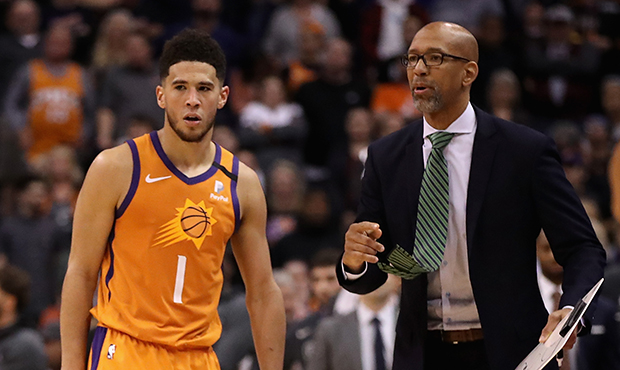
Head coach Monty Williams of the Phoenix Suns talks with Devin Booker #1 during the second half of the NBA game against the Orlando Magic at Talking Stick Resort Arena on January 10, 2020 in Phoenix, Arizona. The Suns defeated the Magic 98-94. (Photo by Christian Petersen/Getty Images)

The Phoenix Suns haven’t made the playoffs for a decade, the second-longest active drought in the NBA and one of the worst overall across the four major professional sports in the United States.

After a strong offseason, the Suns are projected to break that streak, which is more than enough to celebrate.

Head coach Monty Williams, though, is leading a Phoenix team unlike any in the franchise’s 52-year history.

That’s not to say this will be one of the top teams over that half-century, but it’s different in a couple of exciting ways.

Let’s take a journey by combing through that history while comparing the 2020-21 Suns to it. Here are a few of the unique traits for this coming year’s team:

All statistics via NBA.com and Basketball-Reference

Ball-handler firepower

(Photo by Christian Petersen/Getty Images)

Have the Suns had better teams when it comes to star power? Absolutely. Without question.

The combination of Steve Nash and Amar’e Stoudemire benefitted from mutual symmetry on top of their own individual brilliance. There were still independent dual-destructive forces like Charles Barkley and Kevin Johnson, along with a Big 3 before it was cool to have a Big 3 in Alvan Adams, Walter Davis and Paul Westphal.

Those three are far ahead of this upcoming team.

But what about a ball-handler duo? What — and I should preface this with a gag warning — you pictured when hearing about the Backcourt 2000 duo of Jason Kidd and Penny Hardaway?

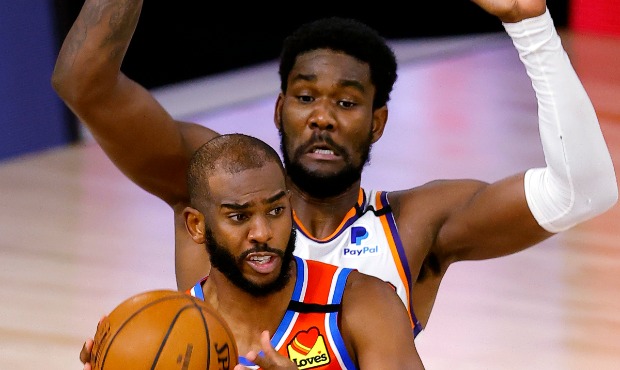
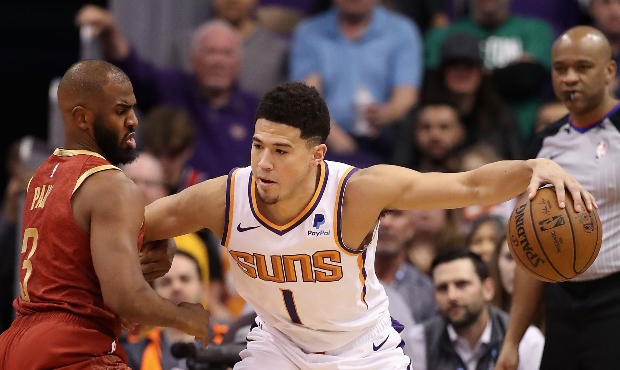
More simply, a backcourt that can do everything you wish of a primary initiator in an offense. Has there been one better than Chris Paul and Devin Booker?

I think not!

For the sake of argument, let’s try our best to find these other complete ball-handlers in franchise history.

We want someone who can run the show, providing for teammates at a high rate, excelling in a similar way with how they score. And we want efficient buckets too. None of that chucking nonsense.

There’s no fool-proof way to do it statistically, but we’ll try with just three numbers.

We will eliminate three-point percentage, but still reward it by including true shooting percentage, incentivizing the most effective of scorers.

Instead of assists per game, we will go with assist percentage, a better encapsulation of the playmaking load these guys take on for the whole team.

For production, I nominate player efficiency rating (PER), a flawed metric on its own, but one that’ll quickly whittle anyone out who isn’t, well, productive.

Here are the three qualifiers: AST% of at least 30%, a TS% of at least 60% and a PER of at least 20.5.

For reference, Paul last season was 34.0%/61.0%/21.7 and Booker was 30.0%/61.8%/20.6. And remember, even if those two weren’t teammates last year and the dynamic between them isn’t a foregone conclusion, Paul did his sharing in OKC with two other ball-handlers and the same goes for Booker with Ricky Rubio.

Back to our results. Our winners: Steve Nash (six times!) and Kevin Johnson (three times). So, technically, the Suns had that backcourt at one point! Just not when they were both at that level.

But that’s it. Other really, really great players in franchise history don’t come close when you’re talking about true guard skills, the expert craftsmanship in facilitating while scoring methodically.

If we bump the qualifiers way down — let’s go 5% lower for each — we get a couple more K.J. seasons and three nods for Westphal, plus an appearance a piece for Goran Dragic (2013-14) and Eric Bledsoe (16-17).

Taking the AST% to 20% gets us our first pair of teammates, and what was likely your first guess, the late 70s and early 80s runs with Westphal and Davis we already mentioned.

To get our admission rate up and some other duos in the door, going to 20 AST%/50 TS%/17.0 PER, there pops Westphal and Adams in the mid-70s, K.J. and a 33-year-old Davis (!) in the late 80s and the Johnson-Jeff Hornacek tandem that followed. Then there are other Johnson backcourt partners like Elliott Perry (!!), Sam Cassell and Jason Kidd before the arrival of Hardaway alongside Kidd (BACKCOURT 2000!!!!!).

Our modern wing of duos includes the 48-win 2013-14 team led by Dragic and Bledsoe, and then, yes, Bledsoe and Isaiah Thomas, who only did so before the trade deadline frenzy in February 2015. It was working! They should have kept them together!

I will accept all arguments coming my way that contest Paul and Booker as the best backcourt the Suns have ever had, and I could be wrong, but it’s a claim I’m willing to make if Paul is within range of the Second-Team All-NBA Point God Reunion Tour form he captured in Oklahoma City last season.

The value of inexperience

(Kim Klement/Pool Photo via AP)

Zooming out a ways to go more full scale … Not that far out. Take us back in a little bit. Liiiitle more. There we go. Better.

Now that the big dogs are out of the way, let’s look at roster construction.

This team is going to get better as the season goes on in a way few can compare to because of experience. Well, actually, inexperience.

Deandre Ayton, Mikal Bridges and Cam Johnson will likely be among the team’s top-six in minutes per game, with Johnson entering his second season while the 2018 draft class starts year three.

There have been 29 playoff teams in franchise history, and in only two of those seasons have three Suns players finished in the top-six of minutes per game that did not yet have three years of experience. Again, that’s three players entering either season one, two or three of their careers that finished top-six in minutes per game.

So who were the two? They’re rather noteworthy answers.

Firstly, that would be the 55-win, Western Conference finalist 1988-89 Suns with Johnson (second year, 39.2 MPG), Hornacek (third year, 31.9 MPG), Armen Gilliam (second year, 28.6 MPG) and Dan Majerle (rookie, 25.1 MPG).

The other? The 1977-78 gang, another featuring franchise icons in their beginnings like Davis (rookie, 32.0 MPG) and Adams (third year, 27.3 MPG), along with Ron Lee (second year, 23.5 MPG).

Booker doesn’t even make the cut entering his sixth year, but he won’t turn 25 until next October, making him younger this season than Hornacek, Gilliam and Lee were for those respective teams.

This could be one of the best young teams the Suns have ever had in terms of the level of contribution outta the kiddos for a playoff team.

And youth is a common theme across these all-time great Suns teams, including the nine conference finals trips in total for the franchise.

The 1993 NBA Finals team had rookie Richard Dumas. A first-year Adams was a stud immediately for the 1976 finals run, and ditto for Davis in his second season (1978-79). Larry Nance blossomed in his third year (1983-84), we already hit on 1988-89 and that carried over to 1989-90.

Even role players like Cedric Ceballos (1992-93), Jared Dudley (2009-10), Joe Johnson (2004-05) and Boris Diaw (2005-06) gave those terrific groups an extra push.

The 2020-21 Suns can get that from the top of their roster (Booker and Ayton) to the core (Bridges and Johnson). And in what’s an unknown for them, there are big-time improvements that could be coming from any of those four.

Shooting, shooting, shooting

(Photo by Mike Ehrmann/Getty Images)

Stylistically for this team, the most obvious area to spotlight is shooting.

Looking at last season’s numbers, including Cameron Payne’s eight-game sample size and Jalen Smith’s sophomore year at Maryland, the Suns have 11 certified three-point shooting threats on their roster who shot at least 35% from deep.

Everyone who is projected to play in the rotation except for Jae Crowder is in that cluster, as Crowder’s volatile percentages can have him go from 29.3% in Memphis to 44.5% in Miami over the course of one season. Let’s say the Suns get closer to Miami Crowder than Memphis, then that’s a full dozen good shooters.

If someone was crazy enough to add up the over 2,400 attempts those guys took across different teams, they’d land on a three-point percentage as a 12-man unit of 37.2%.

That’s a top 10 mark in franchise history. But the groups above it in the rankings aren’t really comparable based on the sheer volume of treys this group will be hucking up. For goodness sake, Cotton Fitzsimmons’ 1991-92 bunch attempted only 7.3 threes a game. Cam Johnson might break that on his own this season after posting 7.8 per 36 minutes as a rookie.

The best team to line up comparatively is the 2005-06 team, which shot 39.9% on 25.6 threes a game and had eight players by the end of the season taking at least a pair a night. That, also, was after mid-season acquisitions Jim Jackson and Tim Thomas joined the fray.

Six of those eight Suns converted at least 38% of their attempts, including current general manager James Jones. Playing with Steve Nash in that Mike D’Antoni madness, of course, an overwhelming majority of those shots were catch-and-shoot looks.

Given Booker and Paul will be playing off each other more with the big fella sucking the defense into the middle, there are notable increases that should be coming via more catch-and-shoot looks to bump up that three-point percentage. Which, duh, of course. But stick with me.

The three players on this season’s team with the highest usage percentages last year have discernible jumps from overall three-point percentage to catch-and-shoot three-point percentage: Booker (35.4% to 39.3%), E’Twaun Moore (37.7% to 41.2%) and Paul (36.5% to 42.3%).

Add in Jevon Carter, Langston Galloway and Cam Johnson’s marks all hitting at least 39% overall and we’ve tidily matched those six from the 2005-06 squad. I snuck that up on ya, didn’t I?

So, the quantity of shooters is a landslide, and the quality of shooters isn’t all that far off. We didn’t even get to Ayton yet, who could see the team reach a baker’s dozen of snipers if he walks the walk he’s been talking about extending his range.

And going back to his 11 teammates, would you be able to guess who had the worst percentage last season? Why, yes, it is Booker. How’d you know? What’s that? I wouldn’t have asked otherwise? Ah, touche, reader. Touche. Just having a conversation with an imaginary reader. Nothing to see here.

Any way you stack it, this will be the Suns’ most versatile shooting team ever, and probably one of the best.

Defensive build

(Photo by Mike Ehrmann/Getty Images)

How about defense? Yes! That other part of basketball! The one the Suns haven’t been top-10 in for 18 seasons!

We have to travel back to the 2002-03 season to find it, and they squeaked in at 10th for defensive rating, the amount of points a team allows per 100 possessions.

It’s the other half of the game Suns teams have rarely ever been known for, but this could be one of the exceptions.

After Phoenix finished top-10 in defensive rating for five straight seasons from the late 80s to early 90s, culminating with the NBA Finals run, it was a two-year blip at the turn of the millennium as one of the league’s best.

That’s the last time Phoenix had a truly great defensive team, and a good example to weigh up against this roster.

The 1999-2000 Suns were third in defensive rating and then second the following season. The team was led by head coach Scott Skiles, who replaced Danny Ainge 20 games into that 1999-2000 campaign.

Over that two-year stretch, there were key attributes that this year’s group shares.

Jason Kidd was at the helm of those teams, firmly entering the prime of his late 20s. He had earned First Team NBA All-Defense the season prior, and then made the second team with forward Cliff Robinson for that 1999-2000 run. It’s the only time in franchise history two Suns players received an All-Defense nod the same season.

Kidd was the leader and voice at point guard, and while Paul is beyond his peak as a defender, he’s tied with Kidd for sixth all-time in All-Defense Teams made with nine.

The versatility from Robinson and a young Shawn Marion is where Bridges comes up, and the toughness through Tom Gugliotta and Rodney Rogers is a modern-day comp for Crowder.

Ayton is the key differentiator and the piece that will likely swing how good (or bad) this season’s Suns defense is, as his speed at his size gives him an almost immeasurable ceiling as a defender.

He has the ability to switch out and stick on guards, what he was best at as a rookie. Ayton grew in year two as an anchor, showing a much better feel for his positioning defending ball screens. He improved with his spacing between the ball-handler, his man and the rim.

Marion is the only comparable defender the organization has had when looking at what’s possible for Ayton’s versatility. This is the only part of this exercise where we’ll go into projectables, but if Ayton improves in his third season at the same rate he did over his first two, this will be Phoenix’s first good defensive team in nearly two decades.

And if he makes a big jump, one that should be borderline expected of a player with his talent, it will be a great defensive team.

Let's block ads! (Why?)


"like this" - Google News
December 01, 2020 at 11:59PM
https://ift.tt/3lqSOdZ

Phoenix has never seen a Suns team like this one before - Arizona Sports
"like this" - Google News
https://ift.tt/2MWhj4t
Shoes Man Tutorial
Pos News Update
Meme Update
Korean Entertainment News
Japan News Update

Who are Maryland’s electors? Must they vote for Biden? Here’s what to know about the process. - Baltimore Sun

adanyabegini.blogspot.com

Unfortunately, our website is currently unavailable in most European countries. We are engaged on the issue and committed to looking at options that support our full range of digital offerings to the EU market. We continue to identify technical compliance solutions that will provide all readers with our award-winning journalism.

Let's block ads! (Why?)


"here" - Google News
December 01, 2020 at 05:03PM
https://ift.tt/2HXy9AF

Who are Maryland’s electors? Must they vote for Biden? Here’s what to know about the process. - Baltimore Sun
"here" - Google News
https://ift.tt/2z7PfXP
https://ift.tt/2Yv8ZPx

Covid-19 is a 'split screen' scenario heading into 2021. Here's how the news media should cover it - CNN

adanyabegini.blogspot.com
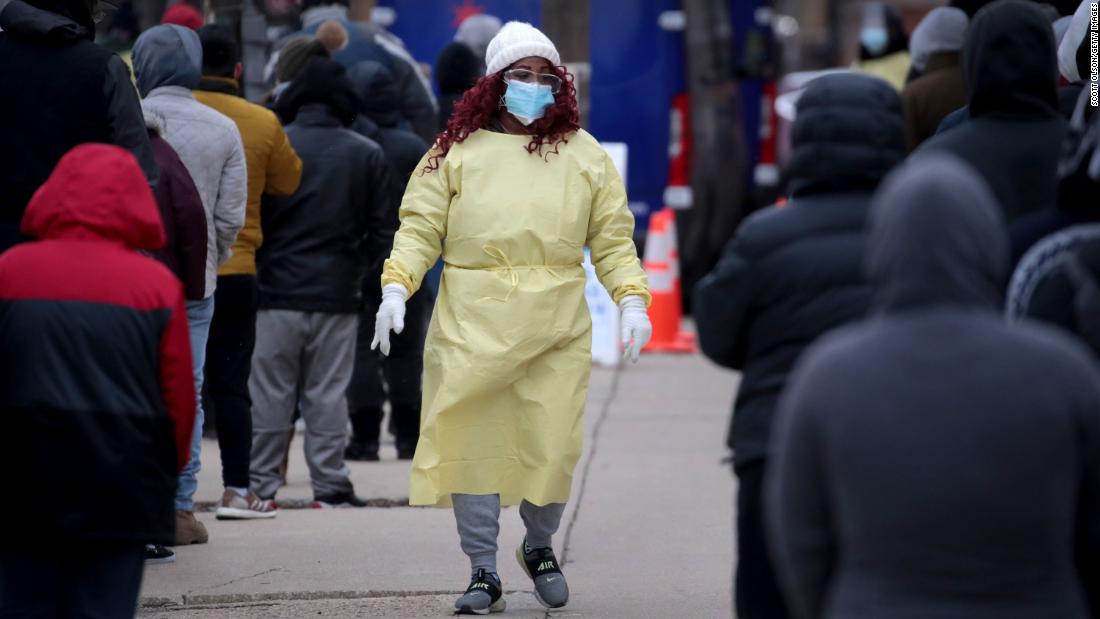
The days are getting shorter. The lines for Covid-19 testing are getting longer. The case counts are getting scarier and the warnings from public health experts are getting more and more dire.
At the same time, the prospects for publicly available vaccines are looking better and better. So how should the news media balance the bleak Covid winter with the hopeful news about all the help that's on the way? I asked several experts on Monday and came away with valuable insights.
"Realism is important," University of North Carolina at Chapel Hill professor Zeynep Tufekci told me. "The good news is really good, but that doesn't take away from the challenges we still face and the tough winter ahead with surging cases across the nation, overloaded hospitals and overworked health-care workers. So I think it's a matter of being realistic on both counts, the good and the bad."
Tufekci has authored several acclaimed pieces about the pandemic this year. Her latest, on Monday, was about the "pandemic heroes who gave us the gift of time and gift of information," helping companies to develop vaccines in record time. Speaking of the vaccines.

The 2021 "split screen"

"If 2020 was one long episode of misery, 2021 will be a split screen," Juliette Kayyemsaid. Kayyem is a homeland security expert, a lecturer at Harvard's Kennedy School of Government and a CNN analyst. She said "reporters must continue to expose the tragedy of this pandemic and our government's response, but also capture the glimmering light -- that will be brighter over the months as this distribution rolls across the US, delivering a vaccine in waves -- that will get us to normalish."
Kayyem also made the point that "medical stories -- of patients and doctors and the health apparatus -- are so personal, intimate. Supply chain logistics are not." So the story is changing: "We are now pivoting to a story whose success is measured in bulk; it will be messy, and big, and bulky, and rolling over a long time period. These stories are only interesting when something goes wrong: a missed delivery, a power outage that impacts freezing capacity, a person getting a vaccine who shouldn't yet or one who can't. So, it's worth taking a step back and assessing just how much is getting done -- measured in its totality."
While the vaccines are rolling out, millions of Americans will still be getting sick. "We have to make it through the next two months," said emergency physician and Brown University professor Dr. Megan Ranney, a relatively new addition to CNN's group of medical analysts. "We have to keep hammering home the message that this is a real disease, and there are real things that we can do to prevent the spread."
"You as the media," Ranney said on the phone, "are our best chance of giving a comprehensible and consistent public health message, since our federal government continues to fall down on the job and many state governments continue to fall down on the job."

"The road ahead is bound to be tortuous"

"Covid-19 has never been a one-dimensional story," STAT News co-founder and executive editor Rick Berke pointed out. "For many months, we've seen gradual scientific progress on vaccines and therapeutics even as we've witnessed human tragedy at a breathtaking scale. Journalists have faithfully covered both the hope and the despair."
"In that respect," Berke wrote in an email, "news organizations have a responsibility this winter to keep doing what they have since the start of this crisis — cover all elements of the story. Find ways to tell compelling human stories so that the public doesn't lose sight of the incredible toll Covid-19 is taking on the country. And find ways to reflect the promise of vaccines, while rigorously reporting on their rollout. These vaccines are real lights at the end of the tunnel, but they are not panaceas. There are pressing questions about the vaccines themselves, such as how long they will provide immunity, as well as about how they will be distributed and who will get them first."
Berke raised some key questions -- ones that news outlets need to keep addressing. Readers and viewers need answers to basic inquiries about the vaccines. "The road ahead is bound to be tortuous," he said, "and it's one journalists need to follow."

Another day of record hospitalizations

This just in from CNN Health's Ben Tinker: "A record 96,039 people in the United States are currently hospitalized with Covid-19, according to data published Monday evening by The COVID Tracking Project. This is the third straight day of new record numbers, following a slight dip reported on Friday. The states with the most people currently hospitalized with Covid-19 are Texas, California, Illinois, Ohio and Pennsylvania."

But "we can see the shoreline"

There's just an awful amount of infection rippling through the United States. The NYT's in-house expert, Donald G. McNeil Jr., is out with a new story titled "The Long Darkness Before Dawn," noting that "the number of deaths is rising and seems on track to easily surpass the 2,200-a-day average in the spring, when the pandemic was concentrated in the New York metropolitan area." McNeil says "our failure to protect ourselves has caught up to us."
But his story also describes his "hopeful" view of 2021, thanks to the vaccines on the horizon. Kayyem sounded similarly hopeful -- she told me she was born cautious, but is feeling truly optimistic right now. "As reporters and analysts, I think we can allow ourselves to be," she said. "It's like with sea sickness; the misery seems easier if we can see the shoreline. We can see it." She has even booked a vacation — for this coming August.

The need for leadership

On Monday CNN's Stephen Collinson wrote about a "leaderless America" slipping deep into the Covid winter. President Trump's negligence is only part of the story. Some governors have also been in hiding.
I noted on Sunday's "Reliable Sources" that Florida governor Ron DeSantis was refusing to hold press briefings and relying on video messages about Covid-19 instead. On Monday, for what it's worth, he DID hold a Covid briefing for the first time in four weeks. The first question was posed by a reporter who asked, "Where have you been?" CNN's research found that 14 other governors have only held a single Covid-19 press briefing apiece in the month of November. A majority of the governors are Republicans. These men and women need to be front and center right now!

We'll never know...

I was struck by something that Surgeon General Dr. Jerome Adams said to Bret Baier on "Fox News Sunday." There are "many different things that we could have done differently," Adams said. "This virus has been challenging. I wish that again this hadn't been superimposed on top of an election. I wish that we had been able to come together as a nation and really talk about the science instead of the politics, and that's on all sides, that's all around." The "all sides" comment is a cop-out, but he's right about the terrible timing of this tragedy. We'll never know how different it could have been.

Let's block ads! (Why?)


"here" - Google News
December 01, 2020 at 08:39PM
https://ift.tt/3o7P6b1

Covid-19 is a 'split screen' scenario heading into 2021. Here's how the news media should cover it - CNN
"here" - Google News
https://ift.tt/2z7PfXP
https://ift.tt/2Yv8ZPx

Coronavirus in Michigan: Here’s what to know Dec. 1, 2020 - WDIV ClickOnDetroit

adanyabegini.blogspot.com

DETROIT – The number of confirmed cases of the coronavirus (COVID-19) in Michigan has risen to 360,449 as of Monday, including 9,134 deaths, state officials report.

Monday’s update represents 10,428 new cases and 98 additional deaths over the last two days -- an average of 5,214 cases and 49 deaths per day. On Saturday, the state reported 350,021 total cases and 9,036 deaths.

New COVID-19 cases and deaths continue to rise in Michigan. Testing has increased in recent weeks, with more than 45,000 diagnostic tests reported per day, but the positive rate has increased to near 13% over the last week. Hospitalizations have increased steadily for the last five weeks, including upticks in critical care and ventilator use.

Michigan’s 7-day moving average for daily cases was 6,759 on Sunday, slightly lower than one week ago. The 7-day death average was 82, the highest since May. The state’s fatality rate is 2.6%. The state also reports “active cases,” which were listed at 175,700 on Saturday, near its highest mark on record. More than 165,000 have recovered in Michigan.

According to Johns Hopkins University, more than 5 million have recovered in the U.S., with more than 13.4 million cases reported across the country. More than 267,000 have died in the U.S.

Worldwide, more than 62.9 million people have been confirmed infected and more than 1.46 million have died, according to Johns Hopkins University. The true numbers are certainly much higher, because of limited testing, different ways nations count the dead and deliberate under-reporting by some governments.


Coronavirus headlines:


VIEW: Tracking Michigan COVID-19 testing data

VIEW: Tracking coronavirus cases, outbreaks in Michigan schools


Much of US experiencing ‘severe’ virus outbreaks amid ‘third COVID wave,’ researchers say

Since the summertime, we’ve been following data from Covid Act Now, a group of technologists, epidemiologists, health experts and public policy leaders that monitors and identifies each state’s risk level for a COVID-19 outbreak. For months, the group had only four risk level categories: “low,” “medium,” “high” and “critical.” As of Saturday, however, the group has included a new, fifth risk level: “severe.”

The map of color-coded states in “America’s COVID Warning System,” as the group calls it, is doing just that with its daunting red hues: warning Americans that the entire country has reached a critical moment with the virus. Covid Act Now has even labeled this virus surge as the country’s “third wave” of the coronavirus.

As of Saturday, 20 states -- primarily those in the midwest -- are colored maroon, meaning they are identified as experiencing a “severe outbreak” of COVID-19. Most of the remaining states -- 27, to be exact -- are labeled red, meaning they are experiencing “an active or imminent outbreak,” according to the data.

Michigan is currently labeled as experiencing an active or imminent outbreak, which is considered the critical level.

Read more here.

State suspends 3 liquor licenses, cites 4 establishments

Liquor licenses have been suspended at three Michigan establishments Wednesday for violating the state’s recent public health order meant to slow the spread of coronavirus.

The Michigan Liquor Control Commission issued emergency suspensions of liquor licenses at the following establishments:

  • Jimmy’s Roadhouse in Newaygo, permit held by Cory’s Restaurant, Inc.
  • Brew Works of Fremont in Fremont, permit held by B. and D., LLC
  • The Meeting Place in Fenton, permit held by The Meeting Place, LLC

Officials say all three establishments have violated the Michigan Department of Health and Human Service (MDHHS)’s latest emergency order that prohibits in-person dining services at all bars and restaurants, along with other restrictions affecting high schools, colleges workplaces and more.

Whitmer urges Michiganders to follow COVID rules ahead of Thanksgiving

Michigan Gov. Gretchen Whitmer released a video Tuesday asking residents to follow COVID-19 safety rules over Thanksgiving weekend.

Whitmer is asking Michiganders to wear masks, practice social distancing, wash hands frequently and avoid large gatherings over the holiday.

“Thanksgiving is about taking time to appreciate the things around us as well as give to others,” Whitmer said. “This year in particular, I am thankful for our frontline workers in our hospitals, child care centers, grocery stores, and everyone else who put their lives on the line to protect our families from COVID-19. As the weather gets colder and as cases continue to skyrocket, we must do everything we can to protect these heroes on the front lines. We all have a role to play to keep our family, friends, neighbors, and frontline workers safe. I know this year will be different, but to protect our families, frontline workers, and small businesses, we must make short-term sacrifices for our long-term health.”

Read more here.

What does emergency use of a COVID-19 vaccine mean?

Pfizer formally asked U.S. regulators Friday to allow emergency use of its COVID-19 vaccine. Emergency use of a vaccine is when regulators allow shots to be given to certain people while studies of safety and effectiveness are ongoing.

Before any vaccine is permitted in the U.S., it must be reviewed by the Food and Drug Administration, which requires study in thousands of people. Normally, the process to approve a new vaccine can take about a decade. But the federal government is using various methods to dramatically speed up the process for COVID-19 vaccines.

Can Michigan get COVID-19 curve down enough for new restrictions to end after 3 weeks?

Michigan Gov. Whitmer was asked Thursday if the state can get its COVID-19 curve down enough over the next three weeks to avoid extending the new temporary restrictions on restaurants, schools and other parts of the economy.

“If we see meaningful movement in the right direction, that is possible,” Whitmer said. “That shows that we are capable of getting our arms around this.”

On Thursday Dr. Joneigh Khaldun, the chief medical executive for the Michigan Department of Health and Human Services, said the state’s hospitals are “closer and closer to becoming overwhelmed” and are currently, on average, about 79% full.

Michigan’s ‘3-week pause’ COVID restrictions in effect

Michigan is entering a three-week “pause” to several activities in an effort to help stop a rapid increase in COVID-19 cases, hospitalizations and deaths.

Under new restrictions issued Sunday evening by the Michigan Department of Health and Human Services (MDHHS), here’s what will be closed starting Wednesday, Nov. 18 until Dec. 8 in Michigan.

Note: The map in the article shows the entire state of Michigan under what MDHHS calls risk “Level E” -- read that here.

What’s closed starting Wednesday, Nov. 18:

  • High schools (in-person learning)
  • Theaters, movie theaters, stadiums, arenas,
  • Colleges and universities (in-person learning)
  • Bowling centers, ice skating rinks, indoor water parks
  • Work, when it can be done from home
  • Bingo halls, casinos, arcades
  • Dine-in restaurants and bars (indoor dining)
  • Group fitness classes
  • Personal services (salon, spa) that involve mask removal*
  • Organized sports, except professional sports and certain NCAA sports (Big Ten football, for example)

*For more information, view the MDHHS' official Gatherings and Face Mask emergency order, which goes into effect at 12:01 a.m. Nov. 18, right here.

What remains open during this three-week period:

  • Indoor gatherings are still allowed but only between two households and with no more than 10 people.
  • Small outdoor gatherings (25 people)
  • Retail
  • Preschool through 8th grade (local district choice)
  • Childcare
  • Manufacturing, construction, other that is impossible to do remotely
  • Public transit
  • Hair salons, barber shops, other personal services (Per the MDHHS order -- Section 4.e.: In facilities offering non-essential personal care services, including hair, nail, tanning, massage, traditional spa, tattoo, body art, and piercing services, and similar personal care services, gatherings are only permitted to the extent that services do not involve the removal of face masks. All services must be provided by appointment, and gatherings in waiting areas are prohibited.)
  • Gyms and pools (for individual exercise only)
  • Restaurants and bars (for outdoor dining, takeout, and delivery only)
  • Professional sports (without spectators)
  • Parks and outdoor recreation
  • Funerals (25 people)
  • Health care

Interactive map shows COVID risk by event size in each Michigan county

One of the biggest challenges with containing COVID-19 is trying to limit gatherings -- and a new interactive tool shows just how risky it could be.

Researchers at Georgia Tech released a the “COVID-19 Risk Assessment Planning Tool,” a peer-reviewed resource that tells you the risk of being around someone with COVID-19, by the event size, in each U.S. county, in real-time.

According to the data, as of Nov. 13, at an event with 10 people, the risk of a person present with COVID-19 is 19% in Wayne County, 30% in Macomb County and 24% in Oakland County.

If that event is with 25 people, the risk increases to 41% in Wayne County, 59% in Macomb County and 37% in Oakland County.

At an event with 100 people, risk levels in pretty much every Michigan county surpasses 80%, including some at 99%, like Kent and Calhoun counties.

‘The health care system can capsize’: Michigan hospitals rapidly filling with COVID-19 patients

Michigan hospitals are rapidly filling with COVID-19 patients once again, and experts are warning residents that if this trend continues, it will be disastrous for the state’s health care system.

Brian Peters, the CEO of the Michigan Heath and Hospital Association, spoke about the state’s latest rise in COVID-19 cases during a virtual panel discussion Thursday. The MHA represents all the hospitals and health systems throughout Michigan.

“I can tell you, very clearly, that we are squarely in the midst of a public health crisis,” Peters said.

The MHA is seeing warning signs from all hospitals -- from the small, rural hospitals to the largest urban systems -- in every corner of that state, he said.

“Our hospitals are rapidly filling with COVID-19 patients at a very alarming rate,” Peters said. “If this continues in the coming weeks, we will surpass our all-time record high in terms of COVID-19 inpatient hospitalization numbers here in the state of Michigan.”

Read more here.

Michigan rolls out coronavirus exposure app statewide: How it works, how to download

Michigan is expanding its COVID-19 exposure app for residents to use statewide after a successful pilot program in October.

The anonymous, no cost and voluntary app, piloted in Ingham County and on the campus of Michigan State University last month, lets users know whether they may have recently been exposed to COVID-19. Users can confidentially submit a positive test result into the app and alert others in recent proximity that they may have also been exposed to the virus.

Read about it here.


Coronavirus research headlines:


Michigan COVID-19 daily reported cases since Nov. 1:

  • Nov. 1 -- 3,354 new cases
  • Nov. 2 -- 3,355 new cases
  • Nov. 3 -- 3,106 new cases
  • Nov. 4 -- 4,101 new cases (new single-day record)
  • Nov. 5 -- 5,710 new cases (new single-day record)
  • Nov. 6 -- 3,763 new cases
  • Nov. 7 -- 6,225 new cases (new single-day record)
  • Nov. 8 -- 4,505 new cases
  • Nov. 9 -- 4,505 new cases
  • Nov. 10 -- 6,473 new cases (new single-day record)
  • Nov. 11 -- 6,008 new cases
  • Nov. 12 -- 6,940 new cases (new single-day record)
  • Nov. 13 -- 8,516 new cases (new single-day record)
  • Nov. 14 -- 7,072 new cases
  • Nov. 15 -- 6,381 new cases
  • Nov. 16 -- 6,382 new cases
  • Nov. 17 -- 7,458 new cases
  • Nov. 18 -- 5,772 new cases
  • Nov. 19 -- 7,592 new cases
  • Nov. 20 -- 9,779 new cases (new single-day record)
  • Nov. 21 -- 7,528 new cases
  • Nov. 22 -- 5,755 new cases
  • Nov. 23 -- 5,756 new cases
  • Nov. 24 -- 6,290 new cases
  • Nov. 25 -- 4,273 new cases
  • Nov. 26 -- 8,581 new cases
  • Nov. 27 -- 8,581 new cases
  • Nov. 28 -- 8,080 new cases
  • Nov. 29 -- 5,214 new cases
  • Nov. 30 -- 5,214 new cases

Michigan COVID-19 daily reported deaths since Nov. 1:

  • Nov. 1 -- 8 new deaths
  • Nov. 2 -- 9 new deaths
  • Nov. 3 -- 43 new deaths (17 from vital records)
  • Nov. 4 -- 19 new deaths
  • Nov. 5 -- 51 new deaths (26 from vital records)
  • Nov. 6 -- 43 new deaths
  • Nov. 7 -- 65 new deaths
  • Nov. 8 -- 31 new deaths
  • Nov. 9 -- 31 new deaths
  • Nov. 10 -- 84 new deaths (25 from vital records)
  • Nov. 11 -- 42 new deaths
  • Nov. 12 -- 45 new deaths
  • Nov. 13 -- 118 new deaths (83 from vital records)
  • Nov. 14 -- 65 new deaths (36 from vital records)
  • Nov. 15 -- 27 new deaths
  • Nov. 16 -- 28 new deaths
  • Nov. 17 -- 79 new deaths (24 from vital records)
  • Nov. 18 -- 62 new deaths
  • Nov. 19 -- 134 new deaths (61 from vital records)
  • Nov. 20 -- 53 new deaths
  • Nov. 21 -- 101 new deaths
  • Nov. 22 -- 32 new deaths
  • Nov. 23 -- 33 new deaths
  • Nov. 24 -- 145 new deaths (51 from vital records)
  • Nov. 25 -- 73 new deaths
  • Nov. 26 -- 86 new deaths
  • Nov. 27 -- 86 new deaths
  • Nov. 28 -- 103 new deaths (70 from vital records)
  • Nov. 29 -- 49 new deaths
  • Nov. 30 -- 49 new deaths

Coronavirus resources:


🌟 Become an Insider 🌟

Introducing WDIV Insider: A new way for loyal Local 4 fans to gain access and customize your ClickOnDetroit news experience. This new and free membership is our way of saying thank you — and your way of getting in on the news action. WDIV Insiders will gain exclusive access to the Local 4 team and station, including personalized messages, offers and deals to big events, and an elevated voice in our news coverage. Learn more about WDIV Insider - and sign up here!

Let's block ads! (Why?)


"here" - Google News
December 01, 2020 at 12:00PM
https://ift.tt/2ViYDzw

Coronavirus in Michigan: Here’s what to know Dec. 1, 2020 - WDIV ClickOnDetroit
"here" - Google News
https://ift.tt/2z7PfXP
https://ift.tt/2Yv8ZPx

Search

Featured Post

'Kind of the first time we've had an estimate like this': first CDC study on mold finds it's much deadlier than we thought - Fortune

[unable to retrieve full-text content] 'Kind of the first time we've had an estimate like this': first CDC study on mold finds i...

Postingan Populer