Rechercher dans ce blog

Thursday, April 1, 2021

What elements of college basketball's pandemic season are here to stay? - ESPN

adanyabegini.blogspot.com

INDIANAPOLIS -- In the days leading up to his team's Final Four matchup against Houston on Saturday, Baylor coach Scott Drew will focus primarily on the X's and O's in a game pairing two Texas powerhouses. The Cougars could be a handful. But Drew said he at least knows he'll face that challenge while feeling comfortable on the sideline in casual clothes instead of a suit.

"One thing I know for sure," he said, "is dressing like we do now [shouldn't change]."

That sentiment won't make Drew's tailor happy, but coaches dressing down is but one element of an unprecedented season, impacted by a once-in-a-century pandemic, that college basketball could permanently adopt in the coming seasons.

Stakeholders within the game will welcome a return to the more traditional elements that have shaped the sport. The lively crowds should come back next season and restore the atmosphere that makes college basketball one of the most exciting sports in the country. Apart from that, however, coaches, players and administrators are currently debating whether some of the changes this season, such as creative scheduling, could enhance the game in the future.

Schools were forced to shred their schedules in 2020-21 as conferences focused on solidifying their league slates and avoiding unnecessary risks from traveling or hosting nonconference matchups. That disruption, however, also created opportunities. Teams began to schedule games on the fly, sometimes with just a few days' notice.

UCLA athletic director Martin Jarmond said the future might include major conferences blocking out a stretch of each season that would allow teams to schedule impromptu games.

"[Some] mid-majors do it now, but Power 5 schools should look at having a flex week," Jarmond said. "I would need to think about it more. It's something to look at."

It's an idea that's backed by Craig Robinson, executive director of the National Association of Basketball Coaches, too.

"Teams should be open to playing new opponents and adjusting schedules on the fly if needs arise," he said.

Big Sky Commissioner Tom Wistrcill said his league has already had meetings about possibly maintaining the more fluid scheduling options they used this season. His conference also played Thursday-Saturday, back-to-back matchups throughout the 2020-21 season to cut back on costs and minimize potential COVID-19-related challenges. That could become a permanent fixture in the league, too.

"We haven't made any decisions as a group, but I love the flexible scheduling idea," he said. "I also think some back-to-backs could help reduce travel costs, which have gotten out of hand."

The limited travel, to some coaches and others attached to the game, has been a plus during a one-site NCAA tournament held in Indianapolis in recent weeks. There are no signs that the NCAA will pursue a similar event in the future -- is there a city that could adequately accommodate 68 fan bases at once when spectators return? -- but there are advantages to doing it this way on a more limited scale.

Oklahoma State's Mike Boynton said there could be an opportunity to turn a one-site NCAA tournament into a great event once fans return because it limits the burden on supporters who follow their teams around the country.

"I think [without the pandemic], we can create an even greater environment," he said. "Plus, less stress on families having to travel multiple times in a short span."

play

2:17

No. 11 seed UCLA knocks off 1-seed Michigan as the Bruins advance to the men's Final Four for the 18th time in program history.

Ohio State head coach Chris Holtmann echoed that idea, saying the use of one site, beginning with the Sweet 16, could be a great way to end each season.

"The idea of having one site for the Sweet 16 and Final Four is worth considering, for sure," he said. "I think, in a normal year, it would really add to the experience for both teams and fans."

Not everyone agrees that the one-site format, however, is best for the sport.

After leading his school to the national semifinals for the first time since 1984 on Monday, Houston coach Kelvin Sampson celebrated at Lucas Oil Stadium with his players, but noted the inability to interact with a diverse collection of fans in multiple cities, some of whom don't get regular opportunities to attend games.

"I don't think we should keep it at one central site, though, because I don't think that's fair to the fans," he said. "College basketball is for the players and the fans. ... Not everybody has the money to travel. There is kind of something romantic about applying for NCAA tickets and finding out you got it and planning your year around that. I think there is something really, really exciting about that."

Added Georgia Tech coach Josh Pastner: "I think you have to do multiple cities. That's part of the fanfare. That's part of a home-court advantage."

It's also important to note that this NCAA tournament hasn't happened at one site, or even one city. Early matchups in West Lafayette and Bloomington sent some teams on bus rides around the state.

"Bloomington was an hour and 10 minutes away. It was too far," one Division I coach said. "The games at Hinkle Fieldhouse were [scheduled] too close together. Both teams were on half the practice gym at the same time and only got 30 minutes on the main floor. It felt hurried and rushed."

While the one-site concept generated strong takes on both sides, those who spoke with ESPN seemed to agree that the scheduling shift for the NCAA tournament was a welcome adjustment. The Monday-Tuesday format for the Elite Eight was celebrated by most of those polled. And multiple stakeholders said some of the behind-the-scenes changes, such as videoconference meetings with recruits, might remain -- even when coaches can get back on the road.

Other intricacies that players, staffers and coaches noticed -- and the casual fan might have ignored -- could affect the game in the future, too. Widened areas around team benches -- another COVID-19-related adjustment this season -- were necessary but challenging, per multiple people who spoke to ESPN.

"I hope we return the benches to normal," Holtmann said. "I think it limited the camaraderie of the game experience for a team this season."

The limited capacity in arenas, however, made the energy within each team a vital resource during games. Purdue coach Matt Painter said he'll continue to demand that support from his team even when crowds return and "keep the emphasis of bringing energy like you would in an empty gym."

He also said health protocols and precautions around interacting with one another could remain when buildings are full again. Painter said he thinks teams will continue to wear masks and employ other precautions while traveling.

Pastner said he thinks we've seen our last handshake lines in college basketball. Even though the country's vaccination rate continues to increase, he said coaches are now more understanding and cautious of how other illnesses, such as the common cold or flu, could spread to a team and impact its season if they're not careful.

"I think we should avoid shaking hands after the game," said Pastner, who added that he doesn't think his players will share hotel rooms in the future. "I think a fist bump, that's here to stay."

With all of these ideas and concepts in flux, college basketball will have to make a number of decisions about what worked and what didn't in the testing ground that was the 2020-21 season. Per Robinson, college basketball's powerbrokers and leaders have to be open to conversations about keeping some elements of this chaotic season, if they will help the game.

"A lot of changes were necessary this season, such as unique conference schedules and altered NCAA tournament game days," he said. "Whether or not these changes remain permanent, our sport should maintain this receptiveness to new ideas. We don't necessarily have to go back to the way things always were."

Let's block ads! (Why?)


"here" - Google News
April 01, 2021 at 06:09PM
https://ift.tt/3rFGxFL

What elements of college basketball's pandemic season are here to stay? - ESPN
"here" - Google News
https://ift.tt/2z7PfXP
https://ift.tt/2Yv8ZPx

Myanmar’s Military Is Killing People for Telling Stories Like This One - Rolling Stone

On the morning of February 1st, the people of Myanmar awoke to the news that life as they knew it had come to an end. The internet was cut, phone lines were down, and a military-run TV channel announced a one-year state of emergency in which the country would be run by Senior Gen. Min Aung Hlaing. Before that broadcast, the military had rounded up leaders of the country’s civilian party, the National League for Democracy, in early morning raids, detaining them along with activists, public intellectuals, and other politicians. In last November’s election, the NLD had obtained 396 seats in parliament, while the military had secured only 33. The new parliamentary session was supposed to begin later that day.

For the past decade, before the February 1st coup, Myanmar (a former British colony also known as Burma) had been held up as something akin to a triumph of democracy. But the reality was always more complicated: The military had ceded some control to democratically elected officials, but it retained much of the power for itself. Even as the country touted its “free” elections in 2010 and 2015 — and as its citizens began to enjoy freedoms they’d never known in their lifetimes — a quarter of the seats in parliament were reserved for officers of the Tatmadaw, as the military is known. One of the country’s two vice presidents was appointed by the military, a number of its ministries were reserved for military officials, and the Tatmadaw held control or ownership of over 100 companies and two of Myanmar’s largest banks, accounting for a massive share of the country’s economy. Aung San Suu Kyi, the leader of the NLD and winner of a 1991 Nobel Peace Prize for her nonviolent resistance to military rule, maintained only frosty relations with Min Aung Hlaing; yet when the military’s attack of the Rohingya ethnic group forced 750,000 to flee to neighboring Bangladesh, she did not condemn the ethnic cleansing. In fact, she defended the Tatmadaw’s actions at the Hague, sacrificing her reputation in the international community in deference to a military that could seize back power at any time.

Last month it did. Since then, a population that had grown accustomed to some democratic norms has faced the horror of isolation (limited internet has been restored, but Facebook, Twitter, and other sites have been blocked) and persecution. What began with a crackdown on peaceful protests has led to a campaign of terror in which the military has begun to systemically massacre its own people, including children as young as five. “We are being brutalized,” says Darko C., an indie-rock musician whose work bringing out the vote in the past election has now forced him into hiding in Myanmar. When Darko (not his real name, but the one under which he performs) reached out to Rolling Stone, he was desperate for the world to know what was really happening in his country. “I want people to be aware of this, because I believe in people. I don’t believe in institutions or organizations, but I have hope in people to intervene in this madness.”

Thus far, news out of the country has been extremely limited, and there are no trustworthy government sources. In the fog of disinformation, it is difficult to verify any accounts. And yet, a growing body of evidence has led U.N. officials to claim that the military’s actions against civilians “likely meet the threshold for crimes against humanity.” Here, edited for length and clarity, is what Darko had to share about a nation in crisis, and a people under attack.

When did you first find out that something was wrong?
On February 1st. The coup happened around, I think, 3 a.m. in Naypyidaw. But when I woke up that morning, I didn’t check any social media or news. I [did] my morning meditation session, and then my wife came back from a bazaar. She went for shopping, and then she told me that our phone connections were cut, internet’s cut, and there was coup in Naypyidaw, which is the new capital of Myanmar. Yangon used to be the capital, and it is still the capital in people’s heart. Naypyidaw is a new city, and it is structured to make a coup very easy — now every official [is] in that area. So they were preparing to do something like this.

When you heard that, were you completely shocked? Was it completely out of the blue?
Yeah, completely out of the blue. But it was weird. I was not shocked at all — maybe it was unbelievable, you know? Like, there were some rumors about a possible coup, but we did not take it seriously because it doesn’t make any sense right now. You know, it would be extremely stupid to go backward like that. Nobody believes in that shit. Even though there was a coup, on that day I thought it would be just to threaten the government to take [the military] seriously, to talk or to have a dialogue with them, to have a negotiation to share the power. That’s what I thought. But, yeah, it turned out to be real. It was real.

Those first few days, when a lot of people were still hearing the rumor about how staying inside for 72 hours would help, what was it like out on the streets? What does it feel like and what are you thinking on day two, three, four, five?
It was like a dead city. During the first week, it was very much like Covid lockdown. Everything stopped because no one feels safe going out — or maybe they were too sad. Everyone was very cautious, very quiet, really sad. There was almost no one in the streets.

That was for the first week. And then on the second week, everybody was going out. From the eighth day, there were massive rallies, getting bigger and bigger. We brought some snare drums, and some floor toms, and some speakers too, to spice up the rallies and protests a little bit. These small groups of like five or 10 people became thousands.

So basically people are just seeing other people starting to protest and joining in?
Yeah, there was no single leader [of] these protests. So it is good and bad. The good thing is it fucked up the military’s [ability] to search and destroy the leaders — because there are no leaders. So it made them confused. Normally there would be a few leaders, so that, you know, they can search them and take them and everyone will become quiet. But this time, everyone was super furious with their coup, and everyone was pushing back. This is not about a political dispute or whatever; it is actually about our futures [having] been robbed. Everyone knows that. We only had 10 years of a little bit of an infant democracy, and a little bit of freedom and a little bit of freedom of expression. Now it is grabbed. There’s actually only a little chance of winning, but nobody wants to give up, because we can’t live another 50 years of dictatorship. We saw what happened then. We know what’s going to happen to us. So this is now going to become a civil war.

When did the military start cracking down on these protests?
A 19-year-old girl called Myat Thet Thet Khaing was shot dead in the head by a police officer. That’s how it started. Now it’s 183 people shot dead [RS note: The most recent estimate is more than 500, including a number of children]. I don’t remember on which day they started showing up, blocking the streets, blocking the road, trying to scare the students. Now we are being butchered. For example, some NLD party members were just taken at night, and their bodies were sent to their families the next day. There was no explanation. There was no law, actually. Nobody was going to trial, prison, or nothing. They didn’t even provide the cause of death. There were so many bruises on the bodies and the face. One guy, there was no teeth in his body, and there was no organ in his body. What did they do to him in just one night? They took him at night, and just called the family to get his body. So I don’t know. They are trying to scare the people.

Also, they arrest the students, the protesters, and then when they grab them, to some people, they point a gun to their head and shoot in the street. What kind of terrorists would do such things in public? And these kids are only like 19 or 17 years old. I mean, they’re harmless. They’re kids.

How have protesters adapted to the crackdown?
Right now, the protests became more like defense. We all are building barricades and bunkers, blocking the military trucks from coming into our own streets. If they come, people start throwing Molotov cocktails and everything that we have, but of course, we know we can’t win with these little weapons, this resistance. We know we can’t fight them back with Molotov cocktails and bricks and stones. But people are doing the best we can just because we don’t want to bow down to this military. We don’t want to give up just because of the guns and because they can kill us easily. Everybody is ready to fight back, and now everybody is preparing for getting a gun, too. But this is not Texas — I’ve been to Texas, by the way. I’ve been to South by Southwest.

What is day-to-day life like for people in Myanmar right now? Is normal life just destroyed?
Normal life is gone now. There is no normal life anymore. I mean, everything is closed. Everything has stopped. All the food coming from outside of the city stopped. There’s no transportation, no buses. People are staying inside. We heard the internet will be cut off soon, and also electricity might be cut off too. All the banks are closed, we can’t even withdraw our own money. We are eating what we have, and people are helping each other. The good thing is people are helping each other. The next thing is a starvation. I think the starvation will come.

So the situation is really deteriorating?
Right now, every day is escalating. Every night there were more arrests, more arrests, more arrests. Every day is getting worse and worse. The violence and the horror is more and more. Nobody is safe. Anything can happen. Now they are stopping and searching cars. They will search your purse. If they see money inside, they would take it. They’re not even acting like security forces, they are acting like bandits. They are bandits, actually. They are terrorist bandits.

I think that what [the junta] are doing [is] pushing all the people to be extremely angry and furious to kill them back. That’s what they want. I think they are asking for it. So then maybe they can shoot more and [say] they are doing the right thing to control the situation, or something like that. That’s what I feel. Everybody is thinking about defense and fighting back, actually. Almost everybody is preparing for war.

And you personally know people who’ve been detained by the military?
One of my friends, who is a singer of a reggae band called One Love, he was taken on the first of February. His name is Saw Poe Kwar, and he was known as kind of NLD lobby because he promoted National League for Democracy and their leaders. Nobody knows where he is right now.

When you heard that he was taken, were you afraid that they might come for you?
Yes, of course. I don’t want to lie about it. Saw Phoe Kwar was in one of the bands in this program called Rock Your Vote, like urging young people to vote. My band, Side Effect, was in it too. There was a talk show plus live performances in a studio, and a projection of a music video urging young people to vote. So we did something that [the junta] didn’t like. It actually really worked, and it went viral among young people. And maybe that’s why now a lot of young people are super pissed when their votes are ignored or robbed.

You feel that having done that program together, you would be someone who would be a—
Target. Yes, of course a target. I’m sure I’m on their list somewhere. And not only because of that. I mean, I’m friends with activists, strong activists. So I started calling them, and I was advised to go somewhere. My friends’ houses were searched by the police and security forces when they were not there. That’s when I realized, OK, maybe I should be somewhere else. I don’t want to be taken too easily.

When did you start going into hiding?
I think it was in the second week, when I started going out for the protests. I mean, everyone was doing it, and I know they can’t take everyone, but if they want someone, they can use it as a kind of reason.  And of course, you know, I could be on the list. If I stay in my house, they know exactly where I’m registered, and they can come at night. They can just knock your door. So now I’m somewhere else. They have no idea.

What do you remember from 10 years ago? What was life like under military rule?
That’s true trauma. First of all, you would be intimidated every time you see a man in uniform. And you had no rights at all. You needed to be related to a military family, or know someone related to their family, or nobody can protect you. And there are some laws, but law and order — they define whatever they want and they could do whatever they want to do. They can knock on your door in the middle of the night, and they can take you just to, you know, ask a few questions, and you will never show up again. And no one knows what happened to you — that kind of thing. We knew it could happen every night. And that’s how we lived.

The education system was also totally fucked up. They did it really on purpose, they destroyed the Burmese education system completely, because they can control stupid people easier than smart people. Also, businesses, I mean, you can’t even imagine how they control the businesses. You can’t make any businesses normally because everything is in their hands and they do whatever they want.

In your profession as a musician, how did the military rule affect your work specifically?
We could not sing a song that criticized them even indirectly. There was severe censorship, a censor board, where my songs were censored — just for writing about sex! Sex was not discussable in public. One of my friends got banned for six months after they were not happy with the songs that they already approved. Can you imagine? Crazy.

So every song you wrote had to be approved by the censorship board?
Yes, but there are a few ways to get around it. They censor our song, and what I did is I changed some lyrics that they didn’t like — that they underlined with a red pen — and I rerecorded it and sent it to them, and they said, “OK, approved.” But then when I released it, I released the original version.

And they just never followed up?
Never found out. Of course, they would not listen to my music because they are lazy people. And I knew they actually didn’t even care about it; they were just showing off their power or control.

You lived through something like the current coup before, in 1988, when the military violently repressed a pro-democracy movement to preserve its power. What similarities and differences do you see from then?
In 1988, I was seven. Exactly my son’s age, right now. So that’s why on the first week, I was extremely sad whenever I looked at my son, you know?  Because I knew how I had to struggle, how I had to work so much harder than the people or the artists from the other side of the world, just because I was born in Myanmar, just because I was born in this fucking shithole here. And I thought my son would not have to go [through] the same process, because things looked better. I was so hopeful. And now when I look at my son, oh, my God, he has to do it all over again.

How much of what’s going on does your son know about? And what does he say about it?
Oh, he knows pretty much of everything. I explained it to him. I even explain to him a little bit of what happened back in the days and that this is history repeating itself, and stuff like that. He’s not very shocked. But one of the safe houses where [we were] staying, we had a lot of gunshots and these sound grenades. And my son got used to it. I mean, he was not even afraid. Every morning the police would show up and started shooting — pow-pow-pow-pow-pow-pow-pow —a lot of shots, and he would keep playing his Minecraft. It became normal. [Voice breaks] That sucks.

You mentioned that some students are hopeful that if the violence escalates, perhaps the international community will step in to help. Do you think that’s a possibility?
They believe in that, because they are young and they believe [in] this globalization. And this is why they are risking their life: “You know, if there are more deaths, the world would probably save us.” And it’s an illusion, Alex. The world will be watching us. And we should be thankful if they are watching us. But we will not be saved by the world. It’s a bitter truth. And it’s really hard for me to convince the young people that they should let go of hope of being saved by the international community. They really believe in it. And I don’t believe in it. We will not be saved by the U.N., for sure. The U.N. will probably release 1,000 more statements, and maybe they will release stronger statements, but … I don’t know.

Where do you think this all is headed?
I don’t think this will be compromised or negotiated. Nobody wants to negotiate with [the military junta]. Everybody wants them out. Also, for them, they cannot go back, too. They committed crimes. They will do whatever it takes. If there’s civil war, I think they would bomb us all. They will use air strikes for sure, on their own civilians. The Myanmar military is preparing for war. I’m not sure if they are expecting U.S. troops or the U.N. troops, as we hope. I’m not sure. But the military is stationing forces in the hospitals, in schools. If the international airstrikes come, they will not bomb the hospitals and the schools, right? See how cruel these motherfuckers are? They took the hospitals and they kicked out the patients.

And this is during a global pandemic, of course. We haven’t even talked about that.
Yeah, exactly. I mean, forget about the pandemic. Nobody is scared of Covid anymore, right now. Nobody is even thinking about it. Now, our true enemy is worse than Covid-19, for sure.

Do you know what’s going on with Aung San Suu Kyi? How do you feel about her and what do you think will happen to her?
I have no idea where she is and what is happening to her. I’m not an Aung San Suu worshiper, you know? I respect her for her commitment and for her sacrifice for the country. She’s a very smart and wise lady, of course. But there are some things that I disagree with. For example, her silence about the Rohingya genocide. I totally understand that she had to be silent, just look away, so that she could continue her work, because there was always a threat of coup, always a threat. But I think the coup is also her fault, too. She knew it was coming. I wonder why she did not send specific letters to international communities stating, “If this happens, please do this and this and this and this.” You feel me? She was so confident and stubborn, you know, showing the middle finger to Ming Aung Hliang, the coup leader. He was not happy. This motherfucker was not happy about this. Now we are suffering from that too, where she could have done something about it. She could have done something about it.

Now she’s stuck too. She’s a great leader but, I mean, I don’t think it’s going to work again. I really hope, during this crazy time, new leaders will emerge. The silver lining of this terrible thing is that the 2008 constitution is gone. We will need a new constitution for sure. It’s 54 million peoples’ life and future.

How are people processing what’s happening?
It’s complicated. There’s mood swings, a lot of mood swings. Sometimes you can relate to somebody’s story and then you’ll be crying, sobbing, weeping. I’m not kidding, you really feel like your own son has died or something. Sometimes when you see the soldiers beating these kids, beating the hell out of little kids, you get fucking angry. But when you think about … I mean, right now, we don’t think about the future. There is no future right now. I can’t even guess what’s going to happen next week. So there’s no future at all. I believed I could die every day.

When was the last time you cried about what is happening?
Oh, it was the day before yesterday. That’s when I saw — oh, my God, I can’t even picture that. Oh, my God — when I saw a young person’s brains out. Fuck, it made me cry. I don’t know. That image stuck in my fucking mind. Fuck. Fuck.

Alex, to be honest, I thought this kind of brutality and these kind of heartless or ruthless killings could only happen in the past, because human beings were stupid back then. I thought, “Now we are more civilized. And now, because of new information flow and globalization and all this, this kind of thing could never happen again. And if this kind of horrible thing [did] happen and [was on] Twitter and everything, the whole world will know it. And the whole world will stop it from happening.” [Voice breaks] But this is an illusion, right? No one can stop it. It is happening. We are being butchered. And if this injustice can happen somewhere in this world, the reality is it can happen everywhere. Democracy, peace, security — they are fragile.

Do you think you might be able to get out of Myanmar? If you could, would you want to?
I do. If I can, yes, because I don’t feel safe. I’m not a pacifist, but I don’t believe in war. I believe in guitars and microphones and, you know, stuff like that. These are my weapons. If I could get out of the country tomorrow, I would.

Let's block ads! (Why?)


"like this" - Google News
April 01, 2021 at 06:00PM
https://ift.tt/2Ocy3Z3

Myanmar’s Military Is Killing People for Telling Stories Like This One - Rolling Stone
"like this" - Google News
https://ift.tt/2MWhj4t
Shoes Man Tutorial
Pos News Update
Meme Update
Korean Entertainment News
Japan News Update

Air Travel Is Already Back to Normal in Some Places. Here’s Where. - The New York Times

adanyabegini.blogspot.com

While airports in major cities are still struggling, some smaller airports that are vacation destinations are busier than before the pandemic.

Note: As of March 13, 2021. Source: Transportation Security Administration, analysis by Kevin Williams

In Florida, Key West International Airport is busier than normal, while Miami International has half as many passengers as it did before the pandemic.

In the West, big-city airports — in San Francisco, Portland, Seattle — are serving a fraction of their typical traveler volume, between 24 percent and 46 percent. But smaller regional airports, near Jackson Hole, Wyo., and Colorado ski country, have passenger volume as much as 12 percent higher than this time last year.

This pattern is typical across the country, detailed new data shows. Large hub airports have just a fraction of the travelers they did at this time last year, even as Americans are returning to flying, particularly to vacation destinations.

“You see airports in Colorado, Montana, Key West having recovered quite a lot,” said Kevin Williams, a Yale economist who studies air travel data. “And then you have a lot of major cities that are still down quite a lot.”

He has compiled granular Transportation Security Administration data that tracks how many people move through airport screening checkpoints. It shows that, with millions being vaccinated daily and states rolling back pandemic restrictions, Americans are returning to leisure travel in large numbers.

Major commuter airports are still far off their prepandemic levels

Passenger volume compared with February 2020 average

Note: As of March 13, 2021. 7-day rolling average of daily passenger volume. Source: Transportation Security Administration, analysis by Kevin Williams.

But airports that serve major cities are still serving far fewer travelers than they did early last year. Washington National, close to the District of Columbia, is down 70 percent in passenger volume. San Francisco International is serving a quarter of its typical volume, and Kennedy Airport in New York is at about one-third.

This may reflect in part the slower return of business travel. These hub airports also tend to have many international flights, which are expected to take longer to recover. Additionally, many urban attractions for leisure travelers — Broadway theaters in New York City, the Smithsonian museums in Washington — remain closed because of the pandemic.

A few dozen smaller airports, where travel is thriving in spite of growing coronavirus case numbers nationally, appear to fall into two categories: those especially close to outdoor vacation destinations, and those serving communities whose residents are more willing to travel amid a pandemic.

Small vacation-oriented airports are nearing normal

Passenger volume compared with February 2020 average

Note: 7-day rolling average of daily passenger volume. Source: Transportation Security Administration, analysis by Kevin Williams.

“The only thing that is different is the masks,” said Richard Strickland, airport director at Key West International, who has flown five times in the last five months. “We’re now busier than we were in 2019.”

Idaho Falls Regional Airport is about two hours from Yellowstone National Park, which attracted many visitors last year. The airport’s passenger volume is now 80 percent of what it was last year — a stronger recovery than at the state’s largest airport, in Boise, which is at roughly 60 percent of its regular travel volume.

Two other airports that serve Yellowstone, one in Wyoming and another in Montana, were fully back to prepandemic travel volume in early March.

“For late summer and through the fall, we were seeing close to the same numbers that we’d had in 2019,” said Rick Cloutier, executive director of the Idaho Falls airport. “We were fortunate recipients of the people’s desire to get to the great outdoors.”

Passenger volume has returned to normal at Canyonlands Field airport in Utah, near Arches National Park. On Florida’s Gulf Coast, airports near beaches are having a similarly good year. There were 24 percent more passengers passing through Northwest Florida Beaches airport in early March than around that time last year.

Airports in one outdoors vacation destination have remained notably empty, though: Hawaii’s airports are down between 51 percent and 84 percent in passenger volume. The state, which has had relatively few Covid cases, requires visitors to obtain a negative test within three days before travel or to quarantine for 10 days upon arrival, making travel there more complicated. The longer time spent on a flight may also scare away potential passengers.

Willingness to travel by airplane may also vary from one city to another. Americans have reacted differently to strategies to minimize the pandemic’s spread, wearing masks and restricting time outside the house to varying levels.

“We seem to have been filling up when everybody else isn’t,” said Steve Gleason, executive director of Provo Municipal Airport. His airport is small — usually just about four or so flights a day — but busy. It’s not especially close to any national park.

Passenger traffic is down 2 percent compared with last year, while Salt Lake City International, an hour away, is still down 40 percent. Mr. Gleason says most of the rebound has to do with passengers traveling to see family through the pandemic or to students who attend Brigham Young University, which is holding in-person classes this semester.

“Most of our traffic is family traffic; they just kept flying,” he said. “It seems like everything shut down pretty solidly for two or three months, and then everybody picked back up again.”

Let's block ads! (Why?)


"here" - Google News
April 01, 2021 at 04:00PM
https://ift.tt/3u4usLU

Air Travel Is Already Back to Normal in Some Places. Here’s Where. - The New York Times
"here" - Google News
https://ift.tt/2z7PfXP
https://ift.tt/2Yv8ZPx

Here’s every batting and pitching record for the Marlins on Opening Day - Fish Stripes

adanyabegini.blogspot.com

There’s a reason to smile today: Opening Day is finally here! After five consecutive losses from 2015 to 2019, the Marlins won their season opener against the Phillies last year. This time, they will try for more of the same when they face the Rays (4:10 ET).

Sandy Alcántara—who is 1-1, 4.50 ERA in two outings against Tampa Bay—is the chosen one by Don Mattingly to lead the rotation and start the first game of the regular season. And just in case something extraordinary happens, here’s your guide of every Marlins record on Opening Day.

Enjoy!

Batting

No Marlin has ever recorded a 5-hit game on Opening Day. However, there are four hitters with a 4-hit performance: Jeff Conine (4-5-1993 vs. Dodgers), Carlos Delgado (4-5-2005 vs. Braves), Hanley Ramírez (4-2-2007 vs. Nationals), and Emilio Bonifacio (4-6-2009 vs. Nationals).

No Marlin has ever recorded a 2-homer game on Opening Day.

Only Marlin to record at least five runs batted in on an Opening Day: Hanley Ramírez (4-6-2009, 5 RBIs vs. Nationals).

There have been four Marlins players with two doubles on an Opening Day: Kevin Orie (4-5-1999 vs Mets), Hanley Ramírez (4-2-2007 vs. Nationals), Casey McGehee (3-31-2014 vs. Rockies), Dee Strange-Gordon (4-5-2016 vs. Tigers).

Six Marlins have recorded a triple on Opening Day history. The latest one came from Derek Dietrich’s bat (3-29-2018 vs Cubs).

Most career hits on Opening Day by a Marlin: Luis Castillo and Hanley Ramírez, both with 10.

Most career home runs on Opening Day by a Marlin: Jeff Conine, 2.

Most career runs batted in on Opening Day by a Marlin: Preston Wilson, 8.

Debuts by position players since 2000 on Opening Day (3):

  • 2B Dan Uggla: 0-for-2 vs Astros (2006).
  • CF Eric Reed: 0-for-2 vs Astros (2006).
  • CF Alejandro De Aza: 2-for-4 vs. Nationals (2007).

Pitching

Only Marlins’ starters to go at least seven innings and allow three or fewer earned runs on Opening Day: Kevin Brown (4-1-1997 vs. Cubs) and Alex Fernández (4-3-2000 vs. Giants).

Most strikeouts on a single Opening Day by a Marlin: Josh Beckett (4-6-2004 vs. Expos) and José Fernández (3-31-2014 vs. Rockies), both with nine.

To date, no Marlin has ever thrown a shutout or a complete game on Opening Day.

There have been four saves by Marlins’ pitchers on Opening Day: Bryan Harvey (1993), Antonio Alfonseca (2000), Armando Benítez (2004), and Brandon Kintzler (2020).

Most starts on Opening Day by a Marlin: Josh Beckett and Josh Johnson (3).

Most career strikeouts on Opening Day: Josh Beckett (16).

Most career wins on Opening Day: Alex Fernández (2).

Debuts by pitchers since 2000 on Opening Day (3):

  • Tommy Phelps: 0.1 IP vs. Phillies (2003).
  • Carlos Martínez: 1.0 IP vs. Astros (2006).
  • Nick Anderson: 0.1 inning vs. Rockies (2019).

BONUS

Last 10 Opening Days:

  • 2011: W 6-2 vs. Mets
  • 2012: L 1-4 vs. Cardinals
  • 2013: L 0-2 vs. Nationals
  • 2014: W 10-1 vs. Rockies
  • 2015: L 1-2 vs. Braves
  • 2016: L 7-8 vs. Tigers
  • 2017: L 2-4 vs. Nationals
  • 2018: L 4-8 vs. Cubs
  • 2019: L 3-6 vs. Rockies
  • 2020: W 5-2 vs. Phillies

Let's block ads! (Why?)


"here" - Google News
April 01, 2021 at 11:00AM
https://ift.tt/3sICRUT

Here’s every batting and pitching record for the Marlins on Opening Day - Fish Stripes
"here" - Google News
https://ift.tt/2z7PfXP
https://ift.tt/2Yv8ZPx

"You Don't Belong Here" | On the Media - WNYC Studios

adanyabegini.blogspot.com

[unable to retrieve full-text content]

"You Don't Belong Here" | On the Media  WNYC Studios

"here" - Google News
April 01, 2021 at 11:05AM
https://ift.tt/3cHYhMy

"You Don't Belong Here" | On the Media - WNYC Studios
"here" - Google News
https://ift.tt/2z7PfXP
https://ift.tt/2Yv8ZPx

Coronavirus in Michigan: Here’s what to know April 1, 2021 - WDIV ClickOnDetroit

adanyabegini.blogspot.com

DETROIT – The number of confirmed cases of the coronavirus (COVID-19) in Michigan has risen to 672,259 as of Wednesday, including 16,092 deaths, state officials report.

Wednesday’s update includes a total of 6,311 new cases and 10 additional deaths. On Tuesday, the state reported 665,948 total cases and 16,082 deaths. It’s the first time Michigan has reported 6,000 cases in a single day since Dec. 5.

Testing has been steady around 35,000 diagnostic tests reported per day on average, with the 7-day positive rate above 12% as of Monday, the highest since early December. The state has reported an up-tick in Hospitalizations over the last several weeks.

Related: Michigan COVID hospitalizations: Concerns grow as more younger adults are in ICU

Michigan’s 7-day moving average for daily cases was 4,680 on Tuesday -- the highest since December. The 7-day death average was 22 on Tuesday and has been flat for several weeks. The state’s fatality rate is 2.4%. The state also reports “active cases,” which were listed at 82,200 on Tuesday. More than 569,000 have recovered in Michigan.

Michigan has reported more than 4.2 million doses of the COVID-19 vaccine administered, as of Tuesday, with 33% of residents having received at least one dose.

More: Whitmer says Michigan plans to combat rising COVID cases with masks, vaccines -- not new restrictions

According to Johns Hopkins University, more than 30.3 million cases have been reported in the U.S., with more than 551,000 deaths reported from the virus.

Worldwide, more than 128 million people have been confirmed infected and more than 2.8 million have died. More than 72 million have recovered, according to Johns Hopkins University. The true numbers are certainly much higher, because of limited testing, different ways nations count the dead and deliberate under-reporting by some governments.


Michigan COVID-19 vaccinations: How to find appointments, info on phases


Coronavirus headlines:


VIEW: Tracking Michigan COVID-19 vaccine doses 💉

VIEW: Tracking coronavirus cases, outbreaks in Michigan schools


Federal officials increasing COVID-19 vaccine doses available for Michigan

Gov. Gretchen Whitmer released a statement Tuesday after White House officials announced that there will increase COVID-19 vaccine doses available for Michigan starting next week.

According to a press release, next week’s shipment will increase by 66,020 bringing the total number of doses to 620,040 -- a weekly record for the state. Officials said the allocation includes 147,800 doses of the single-dose Johnson & Johnson vaccine.

This comes after Whitmer recently requested for more vaccines as the state is seeing a rise in COVID numbers.

CDC: Michigan leads country in new cases of COVID per population

The CDC said that Michigan is leading the country in new cases of COVID-19 per population.

On Tuesday, officials reported 5,177 new COVID cases and 48 additional deaths, including 20 from a Vital Records review. On Monday, the state reported 660,771 total cases and 16,034 deaths.

Local 4′s Dr. Frank McGeorge said he’s seen a very clear increase in COVID patients at the hospital where he works.

“Many of them need to be hospitalized. I would honestly say, this feels worse to me here in Southeast Michigan than it was during the wave that started in November. Now, the most concerning trend is the number of middle-aged people with severe COVID,” McGeorge said.

Detroit expands COVID vaccine eligibility to all residents 16 and older

All Detroiters 16 and older are now eligible for a COVID-19 vaccine, the city announced Monday.

Any Detroit resident age 16 or older can now call to schedule an appointment to be vaccinated at the TCF Center.

Appointments can be made by calling 313-230-0505. Anyone living outside of the city of Detroit, but reporting to work each day in the city, also are eligible to schedule an appointment.

Johnson & Johnson vaccine site opened at Northwest Activities Center 9-1 this Saturday.

Chief Public Health Officer Denise Fair also announced that the Detroit Health Department has been informed it will receive its first allocation of Johnson and Johnson vaccine this week. Detroiters wanting the one dose J&J vaccine can call 313-230-0505 for an appointment to receive at the Northwest Activities Center, located at 18100 Meyers from 9-1 this Saturday.

Michigan: All adults eligible for COVID vaccine April 5

The state of Michigan announced Friday that all residents age 16 and up will become eligible for the COVID-19 vaccine on April 5, nearly a month before the May 1 date pledged by President Joe Biden.

People age 16 to 49 with certain medical conditions or disabilities will qualify starting March 22, when 50- to 64-year-olds can begin getting shots under a previous announcement. Two days later, March 24, a federally selected regional mass vaccination site will open at Detroit’s Ford Field to administer an additional 6,000 doses a day for two months.

Learn more here.

MORE: Michigan’s updated COVID-19 vaccination schedule: Who is eligible and when

Michigan confirms first case of South African COVID variant in Jackson County

The Michigan Department of Health and Human Services announced that the first case of the COVID-19 variant B.1.351 has been identified in a child in Jackson County.

The health department did not say how the boy was infected but a case investigation is underway to determine close contacts and if there are additional cases associated.

This new variant was originally detected in South Africa in October 2020 and shares some mutations with the B117 variant. The first case of the B117 variant -- originally detected in the United Kingdom -- was identified in Washtenaw County.

Michigan loosens COVID restrictions on restaurants -- here are all the details

The state of Michigan has loosened its COVID-19 restrictions on bars and restaurants, including the capacity limit and nightly curfew.

On Tuesday, March 2, Gov. Gretchen Whitmer and the Michigan Department of Health and Human Services announced the restrictions on indoor dining have been revised.

Starting Friday, March 5, Michigan restaurants and bars will be allowed to fill up to 50% capacity, with a maximum of 100 people, according to the state.

“I’m proud that we are able to take this positive step without compromising public health,” Whitmer said.

Since Feb. 1, restaurants had been capped at 25% capacity. From mid-November through the end of January, no indoor dining was allowed at bars or restaurants.

COVID variant cases in Michigan rise by more than 100

The number of the confirmed cases of a more contagious COVID-19 variant in Michigan increased by more than 100 this week, suggesting there is “undetected spread” in the community.

Dr. Joneigh Khaldun, the chief medical director for the Michigan Department of Health and Human Services, said the state has confirmed 422 cases of the COVID-19 B117 variant.

That number increased from 314 cases identified as of six days prior (Feb. 24).

Macomb County offers new COVID-19 vaccination site for seniors 60 and older

Through a partnership with SMART, Macomb County is offering a new vaccination location in Sterling Heights.

The vaccination site is at the Sterling Heights Senior Center on Utica Road, between Schoenherr and Van Dyke roads.

Appointments are required. Eligible residents and workers can call the SMART Macomb Vaccine line at 586-421-6579.

Wayne County announces new vaccination clinics for seniors

Wayne County announced it will open several vaccination clinics for residents 65 and older.

According to county Executive Warren Evans, the vaccination clinics will begin Feb. 23.

“I’m pleased Wayne County is now in a position to begin vaccinating seniors,” Evans said. “I know everyone is eager to safely get back to normal. Our team is working hard to ensure all of our residents can get their COVID shot as quickly as the vaccine is available.”

There are no walk-up appointments and seniors must make an appointment by calling the number for the site in their communities.

The full list of clinics and how to register can be found here.


Michigan COVID-19 daily reported cases since March 1:

  • March 1 -- 785 new cases
  • March 2 -- 1,067 new cases
  • March 3 -- 1,536 new cases
  • March 4 -- 1,526 new cases
  • March 5 -- 1,486 new cases
  • March 6 -- 1,289 new cases
  • March 7 -- 980 new cases
  • March 8 -- 980 new cases
  • March 9 -- 954 new cases
  • March 10 -- 2,316 new cases
  • March 11 -- 2,091 new cases
  • March 12 -- 2,403 new cases
  • March 13 -- 1,659 new cases
  • March 14 -- 1,571 new cases
  • March 15 -- 1,572 new cases
  • March 16 -- 2,048 new cases
  • March 17 -- 3,164 new cases
  • March 18 -- 2,629 new cases
  • March 19 -- 3,730 new cases
  • March 20 -- 2,660 new cases
  • March 21 -- 2,400 new cases
  • March 22 -- 2,401 new cases
  • March 23 -- 3,579 new cases
  • March 24 -- 4,454 new cases
  • March 25 -- 5,224 new cases
  • March 26 -- 5,030 new cases
  • March 27 -- 4,670 new cases
  • March 28 -- 4,101 new cases
  • March 29 -- 4,101 new cases
  • March 30 -- 5,177 new cases
  • March 31 -- 6,311 new cases

Michigan COVID-19 daily reported deaths since March 1:

  • March 1 -- 6 new deaths
  • March 2 -- 24 new deaths (12 from vital records)
  • March 3 -- 5 new deaths
  • March 4 -- 37 new deaths (29 from vital records)
  • March 5 -- 10 new deaths
  • March 6 -- 56 new deaths (48 from vital records)
  • March 7 -- 2 new deaths
  • March 8 -- 2 new deaths
  • March 9 -- 29 new deaths (8 from vital records)
  • March 10 -- 8 new deaths
  • March 11 -- 23 new deaths (16 from vital records)
  • March 12 -- 8 new deaths
  • March 13 -- 38 new deaths (30 from vital records)
  • March 14 -- 4 new deaths
  • March 15 -- 5 new deaths
  • March 16 -- 27 new deaths (6 from vital records)
  • March 17 -- 0 new deaths
  • March 18 -- 25 new deaths (24 from vital records)
  • March 19 -- 15 new deaths
  • March 20 -- 47 new deaths -- (39 from vital records)
  • March 21 -- 3 new deaths
  • March 22 -- 3 new deaths
  • March 23 -- 16 new deaths (8 from vital records)
  • March 24 -- 16 new deaths
  • March 25 -- 49 new deaths (30 from vital records)
  • March 26 -- 20 new deaths
  • March 27 -- 22 new deaths
  • March 28 -- 4 new deaths
  • March 29 -- 4 new deaths
  • March 30 -- 48 new deaths (20 from vital records)
  • March 31 -- 10 new deaths

Coronavirus resources:


🌟 Become an Insider 🌟

Introducing WDIV Insider: A new way for loyal Local 4 fans to gain access and customize your ClickOnDetroit news experience. This new and free membership is our way of saying thank you — and your way of getting in on the news action. WDIV Insiders will gain exclusive access to the Local 4 team and station, including personalized messages, offers and deals to big events, and an elevated voice in our news coverage. Learn more about WDIV Insider - and sign up here!

Let's block ads! (Why?)


"here" - Google News
April 01, 2021 at 11:00AM
https://ift.tt/3rIWNFQ

Coronavirus in Michigan: Here’s what to know April 1, 2021 - WDIV ClickOnDetroit
"here" - Google News
https://ift.tt/2z7PfXP
https://ift.tt/2Yv8ZPx

President Biden unveils his $2 trillion infrastructure plan – here are the details - CNBC

adanyabegini.blogspot.com

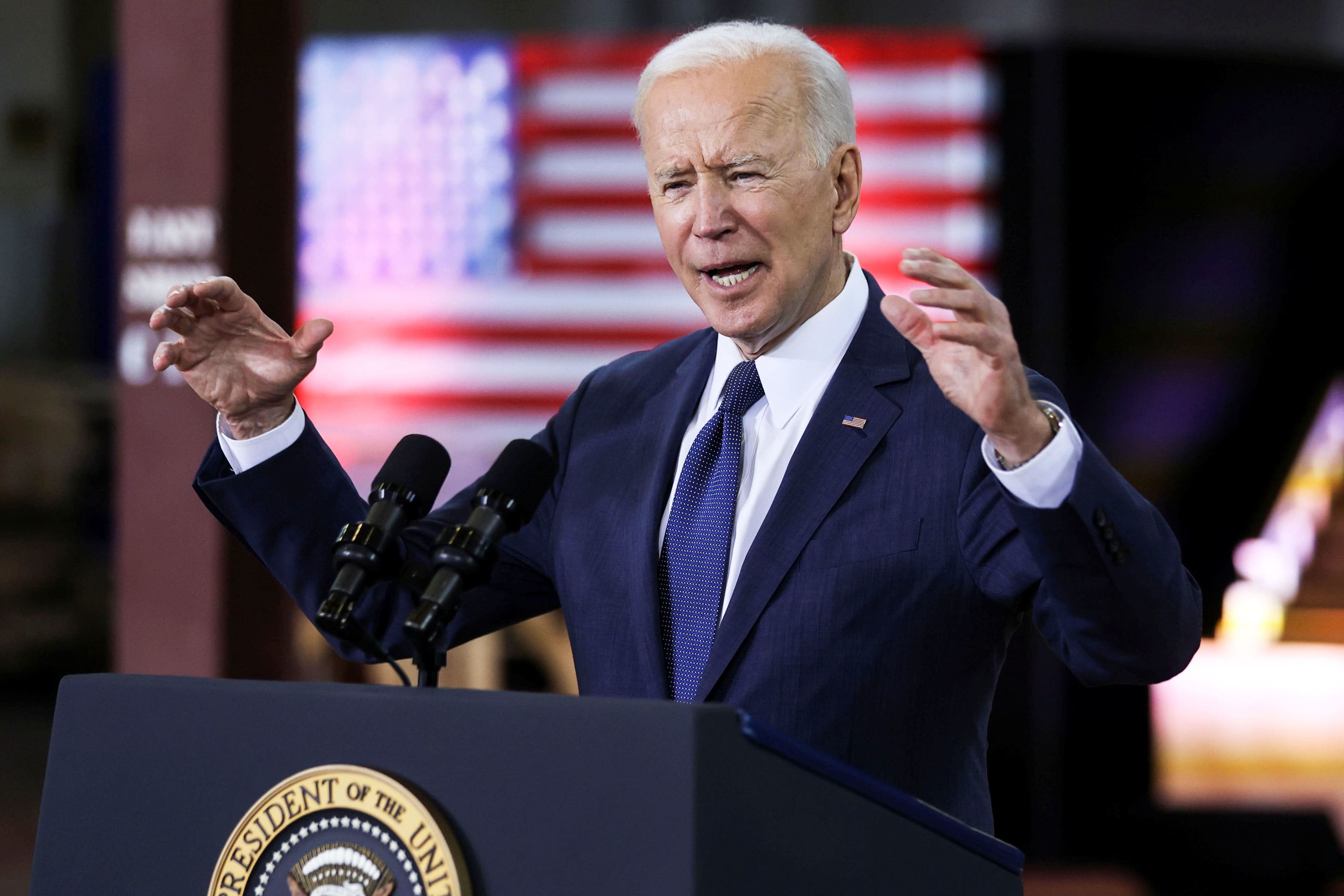
President Joe Biden unveiled a more than $2 trillion infrastructure package on Wednesday as his administration shifts its focus to bolstering the post-pandemic economy.

The plan Biden outlined Wednesday includes roughly $2 trillion in spending over eight years and would raise the corporate tax rate to 28% to fund it. Speaking at a union hall in Pittsburgh, the president called it a vision to create "the strongest, most resilient, innovative economy in the world" — and millions of "good-paying jobs" along the way.

The White House said the tax hike, combined with measures designed to stop offshoring of profits, would fund the infrastructure plan within 15 years.

The proposal would:

  • Put $621 billion into transportation infrastructure such as bridges, roads, public transit, ports, airports and electric vehicle development
  • Direct $400 billion to care for elderly and disabled Americans
  • Inject more than $300 billion into improving drinking-water infrastructure, expanding broadband access and upgrading electric grids
  • Put more than $300 billion into building and retrofitting affordable housing, along with constructing and upgrading schools
  • Invest $580 billion in American manufacturing, research and development and job training efforts
U.S. President Joe Biden speaks about his $2 trillion infrastructure plan during an event to tout the plan at Carpenters Pittsburgh Training Center in Pittsburgh, Pennsylvania, March 31, 2021.
Jonathan Ernst | Reuters

The announcement kicks off Biden's second major initiative after passage of a $1.9 trillion coronavirus relief plan earlier this month. In the new move, the administration aims to approve a first proposal designed to create jobs, revamp U.S. infrastructure and fight climate change before it turns toward a second plan to improve education and expand paid leave and health-care coverage.

Biden said he will unveil the second part of his recovery package "in a few weeks."

"These are investments we have to make," Biden said of revamping U.S. infrastructure. "We can afford to make them. To put it another way — we can't afford not to."

While Democrats narrowly control both chambers of Congress, the party faces challenges in passing the infrastructure plan. The GOP broadly supports efforts to rebuild roads, bridges and airports and expand broadband access, but Republicans oppose tax hikes as part of the process.

Senate Minority Leader Mitch McConnell, R-Ky., said Wednesday he is "not likely" to support the proposal because of the tax increases. Biden called McConnell on Tuesday to brief him on the plan.

McConnell's Democratic counterpart, Majority Leader Chuck Schumer of New York, touted the bill as a means to create jobs while promoting clean energy and transportation. In a statement Wednesday, he said, "I look forward to working with President Biden to pass a big, bold plan that will drive America forward for decades to come."

The president responded to criticism of proposed tax hikes, saying he would not increase the burden on anyone making less than $400,000 per year. He said he did not aim to punish the wealthy.

"This is not to target those who've made it. Not to seek retribution," he said. "This is about opening opportunities for everybody else."

Among the administration's goals, it aims to revamp 20,000 miles of roads and highways and repair 10,000 bridges. The proposal calls to build a national network of 500,000 electric vehicle chargers by 2030 and replace 50,000 diesel public transit vehicles.

The administration hopes to build or rehabilitate 500,000 homes for low- and middle-income Americans and replace all lead pipes in drinking-water systems. The plan also aims to deliver universal, affordable broadband service.

The White House wants to ensure public transportation revitalization reaches communities of color harmed by past projects, such as highways built through neighborhoods. The administration also aims to focus efforts to make homes, schools, transportation and utility grids more resilient in marginalized communities more likely to bear the brunt of severe weather events.

Biden plans to fund the spending by raising the corporate tax rate to 28%. Republicans slashed the levy to 21% from 35% as part of their 2017 tax law.

The administration also wants to boost the global minimum tax for multinational corporations and ensure they pay at least 21% in taxes in any country. The White House aims to discourage firms from listing tax havens as their address and writing off expenses related to offshoring, among other reforms.

Biden hopes the package will create manufacturing jobs and rescue failing American infrastructure as the country tries to emerge from the shadow of Covid-19. He and congressional Democrats also plan to combat climate change and start a transition to cleaner energy sources.

The president announced his plans in Pittsburgh, a city where organized labor has a strong presence and the economy has undergone a shift from traditional manufacturing and mining to health care and technology. Biden, who has pledged to create union jobs as part of the infrastructure plan, launched his presidential campaign at a Pittsburgh union hall in 2019.

Biden has said he hopes to win Republican support for an infrastructure bill. If Democrats cannot get 10 GOP senators on board, they will have to try to pass the bill through budget reconciliation, which would not require any Republicans to back the plan in a chamber split 50-50 by party.

Biden said he would hear out GOP ideas on infrastructure.

"We'll have a good-faith negotiation with any Republican who wants to help get this done," Biden said Wednesday. "But we have to get it done."

Democrats will also have to consider whether to package the physical infrastructure plans with other recovery policies including universal pre-K and expanded paid leave. Republicans likely would not back more spending to boost the social safety net, especially if Democrats move to hike taxes on the wealthy to fund programs.

Schumer on Wednesday also previewed a potential sticking point within his party.

He said he wanted the infrastructure plan to include a repeal of the cap on state and local tax deductions — a change which would disproportionately help higher-income people in high-tax states including New Jersey, Connecticut and Schumer's home state, New York.

Democrats are looking to pass the package this summer. House Speaker Nancy Pelosi told the Democratic caucus in the chamber that she would like to have it passed by July 4, according to a source familiar with the matter. The source, who declined to be named because the remark was made in private, added that it was not intended as a deadline.

Speaking to reporters on Tuesday night, an administration official did not say whether Biden would seek to pass the plan with bipartisan support.

"We will begin and will already have begun to do extensive outreach to our counterparts in Congress," the official said.

Asked Monday about how the bill could pass, White House press secretary Jen Psaki said Biden would "leave the mechanics of bill passing to Leader Schumer and other leaders in Congress."

As of now, Democrats will have two more shots at budget reconciliation before the 2022 midterms. Schumer hopes to persuade the chamber's parliamentarian to allow Democrats to use the process at least once more beyond those two opportunities, according to NBC News.

The party passed its $1.9 trillion coronavirus relief package without a Republican vote.

— CNBC's Kevin Breuninger and Ylan Mui contributed to this report

Subscribe to CNBC on YouTube.

Let's block ads! (Why?)


"here" - Google News
March 31, 2021 at 04:00PM
https://ift.tt/3wdKsx0

President Biden unveils his $2 trillion infrastructure plan – here are the details - CNBC
"here" - Google News
https://ift.tt/2z7PfXP
https://ift.tt/2Yv8ZPx

Search

Featured Post

'Kind of the first time we've had an estimate like this': first CDC study on mold finds it's much deadlier than we thought - Fortune

[unable to retrieve full-text content] 'Kind of the first time we've had an estimate like this': first CDC study on mold finds i...

Postingan Populer