Rechercher dans ce blog

Tuesday, August 2, 2022

In “Renaissance,” Beyoncé Chooses Ecstasy - BuzzFeed News

An important component to both Beyoncé and Lemonade — released during Beyoncé’s mid-30s, a danger zone in our sexist, racist, ageist pop-cultural climate — was how consummately they utilized newfound depth and broader cultural impact to side-step the pop star rat race. Both records centered breathtaking execution, profundity, and the element of surprise to circumvent the search for hit singles, a pursuit that has ruthlessly ended the careers of numerous pop titans. In fact, while each of those albums were massive sellers — both moved over half a million copies in their first weeks alone — neither produced a massive chart-topper, still the de rigueur currency for pop stars and one Beyoncé arguably has not traded in as a solo artist since 2008, when “Sweet Dreams” hit the Hot 100’s top 10.

By announcing the album with six weeks’ notice and releasing its lead single, “Break My Soul,” a few days later, Beyoncé effectively abandoned the shock-and-awe protocol she’d pioneered. “Break My Soul” was immediately notable for its uncomplicated lightness, the first piece of Beyoncé music in more than a decade unburdened from Saying Something. On the contrary, it reveled in being a down-the-middle pop single, complete with obvious, familiar references to ’90s diva house and a big, vaguely empowering, nearly meaningless hook. “You won’t break my soul, and I’m telling everybody,” Beyoncé repeats ad nauseam on the chorus, miles away from the gut-punch specificity of Lemonade-era lyrics like “I like my negro nose with Jackson 5 nostrils.”

If “Break My Soul” was, on one level, a respite from Beyonce’s aggressively thoughtful oeuvre of the 2010s, it also felt vaguely disappointing, a concession from an artist who had so miraculously avoided them for so long. What it had in accessibility, it lacked in the iconoclastic thrill of her recent output.

As a commercial gambit, it only partially worked. “Break My Soul” has sat on the lower rungs of the top 10 for the past few weeks, but it hasn’t exactly reached the sheer inescapability of her peak-era hits like “Crazy in Love,” “Single Ladies (Put a Ring on It),'' or “Halo.” It raised some questions: Was grabbing for a conventional hit single a worthwhile gamble? And would the rest of Renaissance be similarly neutered?

Now that the record is out, the answer to those questions is “maybe” to the first and, joyously, “absolutely not” to the second. Renaissance arrived as planned (despite a leak 36 hours prior) at midnight Friday morning, 16 tracks, unadorned by visual bells and whistles, and with no solemn processing required.

The record is all the better for it.

A carnal dance fantasia of lust, abandon, and release rendered in a continuous mix of some of the most ravishing and inventive production in recent memory, Renaissance needs no accouterments to get its point across. What Beyoncé and her small nation-state of collaborators have achieved is a fusion of her most gleefully unencumbered music to date with the political and social resonance and virtuosic mastery that are her trademarks.

Here, the dance floor is a place for Black and queer revelry-as-resistance. Take “Cozy,” a thick, steamy dancehall track in which Beyoncé coos, “Comfortable in my skin, cozy with who I am,” layered in the mix with another striking observation: “They hate me because they want me / I'm dark brown, dark skin ... that's all me.” This is the kind of euphoric self-empowerment banger, complete with allusions to Black solidarity and beauty, that Lizzo often attempts with much less dexterity; Beyoncé achieves it here without ever losing her edge or, notably in this very chill vocal performance, even breaking a sweat.

Adblock test (Why?)


"like this" - Google News
August 02, 2022 at 04:41AM
https://ift.tt/4PYjhXO

In “Renaissance,” Beyoncé Chooses Ecstasy - BuzzFeed News
"like this" - Google News
https://ift.tt/r0gaY7i
Shoes Man Tutorial
Pos News Update
Meme Update
Korean Entertainment News
Japan News Update

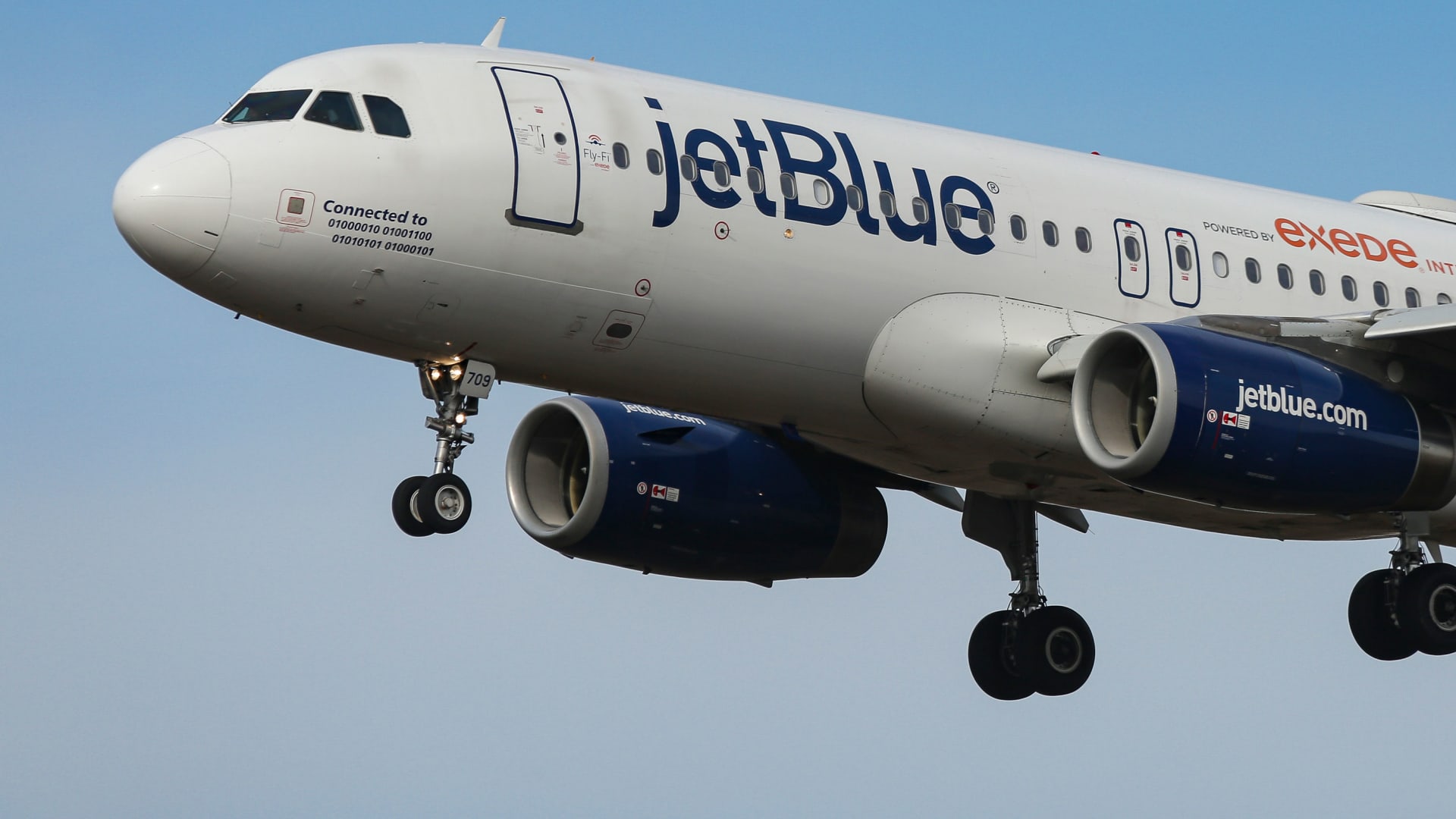
JetBlue shares tumble as costs push it to a loss despite profit forecast on higher fares - CNBC

adanyabegini.blogspot.com

In this article

JetBlue Airways Airbus A320 passenger aircraft landing at John F. Kennedy International Airport in New York City.
Nik Oiko | LightRocket | Getty Images

JetBlue Airways shares tumbled more than 6% Tuesday after a surge in costs drove it to another quarterly loss just as it plans its takeover of Spirit Airlines.

The New York-based airline had a loss of $188 million in the second quarter on record revenue of close to $2.45 billion as it grappled with a nearly 35% increase in cost per available seat mile compared with three years ago. Fuel, labor and other expenses rose sharply last quarter.

Despite the loss, JetBlue said it expects to return to its first profit since the Covid pandemic began this quarter and that it would remain cautious on growth while costs surge.

JetBlue's third-quarter capacity will likely end up being down as much as 3% compared with 2019, a sign the carrier is holding back on growth like other airlines trying to improve reliability after a rocky start to a big summer travel season.

"We reported a record-breaking revenue result for the second quarter, and we're on pace to top it again here in the third quarter and drive our first quarterly profit since the start of the pandemic," CEO Robin Hayes said in an earnings release.

The airline estimated its revenue per available seat mile will be up as much as 23% this quarter as consumers swallowed high airfares that JetBlue expects to offset a jump in fuel costs. Excluding fuel, JetBlue forecast unit costs to be up 15% to 17% over 2019.

The airline said it will complete its retirement of Embraer E190 planes in mid-2025, more than a year earlier than previously scheduled. The faster transition to its more fuel-efficient Airbus A220 planes would help it cut costs, the company said.

Airfares have cooled slightly as the peak summer travel season fades but JetBlue said "early bookings keep us cautiously optimistic about the fall."

JetBlue last week announced it had finally reached a deal to acquire ultra-low-cost carrier Spirit Airlines for $3.8 billion in cash after a long bidding war with discounter Frontier Airlines. Frontier's agreement to combine with Spirit fell apart hours before the JetBlue-Spirit deal was announced.

Adblock test (Why?)


"here" - Google News
August 02, 2022 at 06:31PM
https://ift.tt/Owzb5GF

JetBlue shares tumble as costs push it to a loss despite profit forecast on higher fares - CNBC
"here" - Google News
https://ift.tt/2TXm9PW
https://ift.tt/mt0XUkV

LIV Golf Is Here To Stay - Forbes

adanyabegini.blogspot.com

Conventional wisdom says LIV Golf is a rich kingdom’s folly. But it’s not. It’s a function of basic economics.

While a lot of attention has been paid to LIV Golf paying richer purses and more guaranteed money to golfers than the PGA, that’s not why LIV Golf is here to stay. The PGA has behaved like a stale monopoly for many years. It has caused some of its players to grumble about a lack of financial disclosure, paid its executives too much and failed to deliver for its customers, who often don’t even know where their favorite golfers are going to play.

As Gregory Bresiger reported in June, the PGA took in $1.5 billion in total revenue in 2019—the same year PGA commissioner Jay Monahan received compensation of $8.9 million. Had he been a player on the tour, Bresiger wrote, Monahan’s income would have ranked him second in official PGA Tour money winnings, behind Brooks Koepka’s $9.7 million and ahead of Rory McIlroy’s $7.8 million.

In 2020, the PGA, a “nonprofit,” posted net income of $87 million on revenue of $1.16 billion, with its executives pocketing $34 million in compensation. But its annual report provides little disclosure on details. As far back as 2013, golfers like Greg Norman (now the commissioner of LIV Golf) complained about the PGA’s byzantine record-keeping. “I’ve been asking for an independent audit for years to make sure there is full financial transparency, and it has never been done,” Norman said.

For golf fans and sponsors, the guaranteed purses offered by LIV Golf have a distinct advantage over the PGA beyond dollars and cents. They know who is going to be playing every tournament. As one top golfer recently suggested, create 12 to 14 big events a year where the stars are guaranteed to show up, and the tour will look more attractive to sponsors, TV networks and fans. “The era of maximum playing opportunities needs to go, and the era of the best against the best more often needs to start,” the golfer said. LIV Golf also has a different tournament format.

The PGA’s first reaction to LIV Golf was to ban its newly signed members from PGA events and start a lobbying effort against the Saudi-backed league. The move was dumb and screamed of hypocrisy, given that many of the PGA’s sponsors do business with Saudi Arabia and that the LPGA is backed by Aramco, the Saudi energy and chemical company. The Saudi Public Investment Fund behind LIV Golf even owns a stake in the PGA Tour Fan Shop.

The PGA may have finally awakened from its long slumber. The association just announced that it will increase its prize money to a record $429 million for the 2022-23 season.

The only thing missing for LIV Golf—albeit a huge piece—is a substantial media deal. The PGA recently signed nine-year agreements with CBS, NBC and ESPN+ to broadcast coverage of events through 2030. It’s reported to be worth $700 million a year, amounting to more than $6 billion over the course of the contracts. There’s no reason LIV Golf shouldn’t get something comparable.

Adblock test (Why?)


"here" - Google News
August 02, 2022 at 09:18PM
https://ift.tt/YMjIbNk

LIV Golf Is Here To Stay - Forbes
"here" - Google News
https://ift.tt/2TXm9PW
https://ift.tt/mt0XUkV

TikTok's ties to China are once again under fire in Washington. Here's why - CNN

adanyabegini.blogspot.com

(CNN Business)Two years after then-President Donald Trump said he would ban TikTok in the United States through an executive order, the short-form video platform is once again under scrutiny in Washington. And the underlying issue remains largely the same: TikTok's ties to China through its parent company, Bytedance.

A growing number of US lawmakers are calling for the Biden administration to take action against TikTok, citing apparent national security and data privacy concerns. The criticism stems from a Buzzfeed News report in June that said some US user data has been repeatedly accessed from China. The reporting cited leaked audio recordings of dozens of internal TikTok meetings, including one where a TikTok employee allegedly said, "Everything is seen in China."
In a response to the report, TikTok previously said it "has consistently maintained that our engineers in locations outside of the US, including China, can be granted access to US user data on an as-needed basis under those strict controls." A TikTok executive testified before a Senate panel last year that it doesn't share information with the Chinese government and that a US-based security team decides who can access US user data from China.
The renewed pressure on TikTok comes as the platform's influence continues to grow in the United States. After Trump left office, the Biden administration revoked the executive order and largely walked back official attempts to ban TikTok. Last year, TikTok said it topped 1 billion monthly active users globally, and more than 100 million users are said to be in the United States, according to some market research estimates. Activity on the app continues to shape the news cycle, popular music, culinary trends and more in the country. Meanwhile, other US social media giants continue to imitate TikTok's features in an effort to compete.
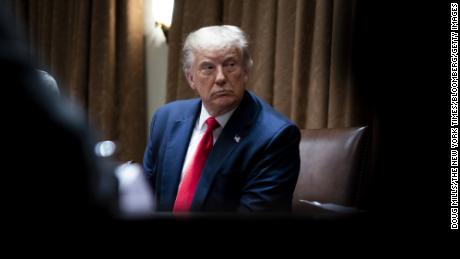
Former President Donald Trump sits during a meeting in the Cabinet Room of the White House in Washington, D.C.,
Some critics previously blasted Trump's crusade against the fast-growing video app as political theater rooted in xenophobia, and called out Trump's odd suggestion that the United States should get a "cut" of any deal if it forced the app's sale to an American firm. But the latest round of pressure from lawmakers on both sides of the aisle shows how the national security issue continues to plague TikTok in the United States, even under a new administration.
Here's what you should know about the latest scrutiny of TikTok and Bytedance along the Beltway.

What lawmakers are saying about TikTok

A range of US lawmakers and officials have in recent months called for new investigations into TikTok's data storage practices or even for the app to be yanked off US app stores.
A coalition of GOP senators led by Tom Cotton of Arkansas sent a letter in June to Treasury Secretary Janet Yellen calling for answers about actions the Biden administration is taking to combat the "the national security and privacy risks posed by TikTok." A separate group of Republican senators led by Marsha Blackburn of Tennessee also sent a letter of questions to TikTok's CEO, Shou Zi Chew. The senators said the recent media reports "confirm what lawmakers long suspected about TikTok and its parent company, ByteDance — they are using their access to a treasure trove of US consumer data to surveil Americans."
Meanwhile, a bipartisan group of lawmakers on the Senate Select Committee on Intelligence urged the Federal Trade Commission to formally investigate TikTok and ByteDance. "In light of repeated misrepresentations by TikTok concerning its data security, data processing, and corporate governance practices, we urge you to act promptly on this matter," the letter signed by Mark Warner of Virginia and Marco Rubio of Florida stated.
A logo of ByteDance at its office in Beijing, China July 7, 2020.
In a letter, a member of the Federal Communications Commission urged Apple and Google to remove TikTok from their app stores. FCC Commissioner Brendan Carr claimed that ByteDance was "beholden" to the Chinese government, and "required by law to comply" with the Chinese government's surveillance demands. The letter was widely reported on, despite the fact that the FCC has no role in overseeing app stores.
In a letter responding to Blackburn and others, Chew said: "We have not provided US user data to the [Communist Party of China], nor would we if asked."

How TikTok has responded

Amid the recent uproar, TikTok announced that it has moved its US user data to Oracle's cloud platform so that "100% of US user traffic" is now hosted by the cloud provider, potentially addressing national security concerns.
In his letter to lawmakers, which mentioned the shift to Oracle, Chew said the broader goal for the company's data security efforts is to build trust and "make substantive progress toward compliance with a final agreement with the US Government that will fully safeguard user data and US national security interests."
Chew didn't name any specific groups within the US government, but the Committee on Foreign Investment in the United States (CFIUS) has been investigating TikTok since 2019. The government body, however, has not provided any recent updates on its investigation. Citing anonymous sources, Reuters recently reported that CFIUS has been in "extensive discussions with TikTok on security issues." Representatives for CFIUS did not immediately respond to a request for comment.
TikTok also recently pledged to offer researchers more transparency about activity on the platform, including access for a select group to its API, or application programming interface.
"We know that just saying 'trust us' is not enough," TikTok chief operating officer Vanessa Pappas said in a blog post announcing the planned update. "That's why long ago we made an important commitment to transparency, particularly when it comes to how we moderate and recommend content."

Why the national security concerns won't go away

While TikTok has long pushed back at the national security concerns as "unfounded," the concerns persist.
"The fact that the Chinese government, if it really wants to, can make any company in its borders comply with data access requests, I think is really at the root of a lot of these concerns about TikTok," said Justin Sherman, a nonresident fellow at the Atlantic Council's Cyber Statecraft Initiative.
"There are real national security questions being asked," Sherman added, but there are also issues with galvanizing much of the conversation around anti-China rhetoric.
Focusing too narrowly on the national origin of an app's owner, or just on a single company, only looks at one way that data can be accessed, Sherman said. As a result, it loses all the other ways that data flows through advertisers, brokers and much more.
"It's good to have this kind of attention" on data privacy and security issues, Sherman said. "But if all you're doing is writing letters about specific companies and not actually writing and testing laws and regulations to control for risks, in the long run, nothing's really going to change too much."

Adblock test (Why?)


"here" - Google News
August 02, 2022 at 08:54PM
https://ift.tt/b3gdYWl

TikTok's ties to China are once again under fire in Washington. Here's why - CNN
"here" - Google News
https://ift.tt/2TXm9PW
https://ift.tt/mt0XUkV

JetBlue shares tumble as costs push it to a loss despite profit forecast on higher fares - CNBC

adanyabegini.blogspot.com

In this article

JetBlue Airways Airbus A320 passenger aircraft landing at John F. Kennedy International Airport in New York City.
Nik Oiko | LightRocket | Getty Images

JetBlue Airways shares tumbled Tuesday after a surge in costs drove it to another quarterly loss just as it plans its takeover of Spirit Airlines.

The New York-based airline had a loss of $188 million in the second quarter on record revenue of close to $2.45 billion as it grappled with a nearly 35% increase in cost per available seat mile compared with three years ago. Fuel, labor and other expenses rose sharply last quarter.

Despite the loss, JetBlue said it expects to return to its first profit since the Covid pandemic began this quarter and that it would remain cautious on growth while costs surge.

JetBlue's third-quarter capacity will likely end up being down as much as 3% compared with 2019, a sign the carrier is holding back on growth like other airlines trying to improve reliability after a rocky start to a big summer travel season.

"We reported a record-breaking revenue result for the second quarter, and we're on pace to top it again here in the third quarter and drive our first quarterly profit since the start of the pandemic," CEO Robin Hayes said in an earnings release.

The airline estimated its revenue per available seat mile will be up as much as 23% this quarter as consumers swallowed high airfares that JetBlue expects to offset a jump in fuel costs. Excluding fuel, JetBlue forecast unit costs to be up 15% to 17% over 2019.

The airline said it will complete its retirement of Embraer E190 planes in mid-2025, more than a year earlier than previously scheduled. The faster transition to its more fuel-efficient Airbus A220 planes would help it cut costs, the company said.

Airfares have cooled slightly as the peak summer travel season fades but JetBlue said "early bookings keep us cautiously optimistic about the fall."

JetBlue last week announced it had finally reached a deal to acquire ultra-low-cost carrier Spirit Airlines for $3.8 billion in cash after a long bidding war with discounter Frontier Airlines. Frontier's agreement to combine with Spirit fell apart hours before the JetBlue-Spirit deal was announced.

JetBlue shares were down about 5% in afternoon trading Tuesday.

Adblock test (Why?)


"here" - Google News
August 02, 2022 at 06:31PM
https://ift.tt/Owzb5GF

JetBlue shares tumble as costs push it to a loss despite profit forecast on higher fares - CNBC
"here" - Google News
https://ift.tt/2TXm9PW
https://ift.tt/mt0XUkV

Monday, August 1, 2022

Josh Hader trade: Padres land All-Star closer from Brewers; here's what blockbuster means for both teams - CBS Sports

adanyabegini.blogspot.com
hader-getty.png
Getty Images

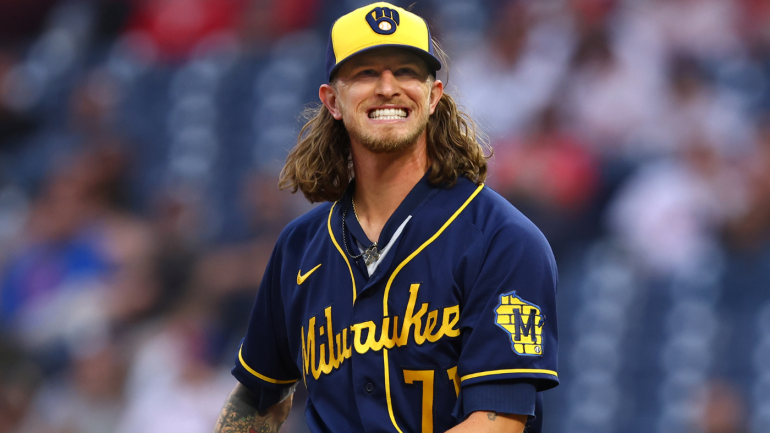
The Milwaukee Brewers have agreed to trade closer Josh Hader to the San Diego Padres, CBS Sports HQ's Jim Bowden confirmed Monday. Milwaukee will receive reliever Taylor Rogers, right-hander Dinelson Lamet and prospects Robert Gasser and Esteury Ruiz in the deal that comes less than 30 hours before Tuesday's trade deadline.

Hader, 28 years old, will qualify for free agency after next season. Because of that, and because of his rising arbitration costs (saves are the one statistic that gets a reliever paid before they hit free agency), the Brewers had been more open-minded about moving him than you might expect from a first-place team.

It's possible that the Brewers felt more empowered to make a deal given that Hader is in the midst of a disappointing effort relative to his norms. In 37 appearances, he's amassed a 4.24 ERA (97 ERA+) and a 4.92 strikeout-to-walk ratio. (For reference, even with his struggles this year, he still has a 2.48 career ERA.)

Hader had been particularly ineffective as of late, with his seasonal ERA increasing from 1.09 at the beginning of July to 4.24 by month's end. Five of the seven home runs he allowed this season were launched over the span of six appearances.

The Brewers didn't necessarily have to have long-term concerns about Hader to justify moving him -- they just had to feel that they could get similar production from Rogers, with the other players serving to balance the fact that Rogers will be a free agent at season's end, a year earlier than Hader. How realistic is that belief? Rogers has also had a worse year than usual, accumulating a 4.35 ERA (87 ERA+) and a 5.33 strikeout-to-walk ratio in 41 innings. For his career, he has a 3.29 ERA in more than 350 big-league innings.

Sportsline projects the trade to favorably impact San Diego in 2022. The Padres' chances of making the playoffs increased from 68.9% to 70.7%, while Milwaukee's decreased slightly from 78.8% to 78.2%.

Looking for more insight on the Hader trade? Fantasy Baseball Today broke down the deal on an emergency episode. Listen below:

What the trade means for the Brewers

Foremost, it means that Milwaukee will have a regular closer who isn't Hader for the first time since he took hold of the ninth inning in 2018. The combination of his recent struggles (as mentioned above) and Devin Williams' continued excellence should make that thought easier to bear for Brewers fans, though it's reasonable to think Milwaukee's bullpen as a whole might take a step backward as a result. (That drop, the Brewers front office seems to be banking on, can be offset with Rogers.)

Hader's departure will also free up funds for the Brewers to allocate elsewhere. He was owed $11 million this season, making him the second highest paid player on Milwaukee's roster, behind Christian Yelich. Granted, the savings won't be felt immediately: Rogers had a full-season salary over $7 million, meaning the difference the rest of the way is less than $2 million between them.

The Brewers also get some additional pitching depth in the form of Lamet, an interesting young hitter in Ruiz, and Gasser, who Baseball America recently ranked as the ninth-best prospect in San Diego's system and a potential back-end starter

What the trade means for the Padres

It's simple. The Padres were able to acquire Hader, possibly the game's best reliever over the course of his career, for a package of extraneous players. Rogers had underperformed and was months away from free agency; Lamet had not demonstrated he belonged on a big-league pitching staff; and neither Ruiz nor Gasser were one of the Padres' best young prospects.

It's rare to be able to land a potential impact talent -- even in the form of a reliever -- without giving up a player the team will definitely miss. The Padres accomplished that here. Even if there is a chance that Hader is on the downswing, it's a worthwhile bet. One that could upgrade the Padres' bullpen without jeopardizing their pursuit of Juan Soto or other trade-deadline additions.

Adblock test (Why?)


"here" - Google News
August 02, 2022 at 02:25AM
https://ift.tt/4UnWEVP

Josh Hader trade: Padres land All-Star closer from Brewers; here's what blockbuster means for both teams - CBS Sports
"here" - Google News
https://ift.tt/zZuH5Uv
https://ift.tt/zEXpvVP

Democrats’ Climate Deal Isn’t Done Yet. Here Are the Remaining Hurdles. - The New York Times

adanyabegini.blogspot.com

An agreement with Senator Joe Manchin III of West Virginia salvaged a key piece of President Biden’s agenda. But Democrats still have a few crucial steps to take before it becomes law.

WASHINGTON — When Senator Joe Manchin III of West Virginia, a key centrist holdout, announced a surprise deal last week with Chuck Schumer of New York, the majority leader, on a climate, energy and tax package, Democrats exulted that a significant piece of their domestic policy agenda had been saved.

But the agreement is anything but a done deal.

Now Democrats are racing to muscle the package — packed with hundreds of billions of dollars in climate and energy proposals, a major drug price reduction initiative, tax increases and health care subsidies — through the evenly divided Senate over united Republican opposition. They are doing so under a process known as budget reconciliation, which allows certain tax and spending bills to move quickly and avoid a filibuster but also is subject to strict rules that limit what can be included.

“Our timeline has not changed, and I expect to bring this legislation to the Senate floor to begin voting this week,” Mr. Schumer said on Monday, speaking on the Senate floor.

Here are the hurdles that remain before President Biden can sign the package into law.

With Republicans unanimously opposed, Democratic leaders need all 50 members of their caucus to remain united behind the legislation.

At least one centrist, Senator Kyrsten Sinema of Arizona, has not said whether she plans to support the legislation, which contains at least one proposal that she has previously opposed: narrowing the so-called carried interest loophole, which allows private equity executives and some wealthy hedge fund managers to avoid the higher tax rates that entry-level employees pay.

A spokeswoman has said that Ms. Sinema continues to review the measure and await guidance from the Senate parliamentarian. Mr. Manchin said he expected to speak with Ms. Sinema on the Senate floor on Monday evening, as senators returned to Washington for votes.

“I haven’t had any conversations with anybody during the process because I wasn’t ever sure that we would get to a finale, to get a completed bill,” he said. Mr. Manchin added that he considered Ms. Sinema a friend and that she had a substantial role in shaping the deal, including in hammering out the prescription drug pricing piece and in scaling back the tax increases.

By using reconciliation, Democrats can bypass Republicans entirely, but they also must adhere to strict budgetary rules that restrict its scope and structure. One major condition, named the Byrd Rule after its architect, former Senator Robert Byrd of West Virginia, includes a ban against any provision that does not directly change revenue or spending.

The arbiter of the rules is the Senate parliamentarian, Elizabeth MacDonough. Along with staff, Ms. MacDonough is scrubbing and analyzing the pieces of the package to determine whether they adhere to the rules, in a process affectionately known on Capitol Hill as a “Byrd bath.” Republicans, who are seeking to derail the legislation, also plan to challenge key elements of the measures as violations of the Byrd Rule.

Democrats have labored for months over the details and expressed confidence that they would be able to preserve its central elements.

“We’re very careful about that,” Mr. Manchin said on Monday, speaking to reporters on Capitol Hill. He added, “There’s an awful lot of good stuff in this bill.”

Mr. Schumer, speaking at a news conference last week, suggested that Democrats might also incorporate additional changes, including a proposal aimed at lowering the price of insulin.

Before voting on final passage, senators will have to sit through 20 hours of debate, evenly divided between both parties, unless they agree to skip some of the time. It is also possible that a Republican will force Senate clerks to read the entirety of the 725-page bill aloud, as a way of objecting to the process, as they did before passage of the $1.9 trillion pandemic aid law last year.

But for Democrats, the biggest hurdle comes after the debate, when the Senate will launch into a rapid-fire series of amendment votes known as a vote-a-rama. That is when the rules allow any senator to offer any proposal with no time limit, usually yielding an hourslong series of politically fraught votes that are designed to sap support for the legislation or put its proponents in a tough spot — or both.

In anticipation of some immigration-related amendments, Senator Bob Menendez, Democrat of New Jersey, called on his colleagues to “defend immigrant communities against the GOP’s plans to use reconciliation to divide us and to advance Trump’s hateful and destructive policies towards immigrants.”

Mr. Manchin, pressed by reporters on Monday, did not explicitly say whether he had committed to voting against any Republican amendments.

“We have a good, balanced piece of legislation. It’s taken me eight months to get here,” Mr. Manchin said. “The process is what it is. You respect the process, and we’ll see what happens.”

In a notice reviewed by The New York Times, Democratic floor staff offered some advance advice for senators and their aides as they looked toward the marathon voting session. “Please be patient, stay hydrated, wear comfortable shoes, bring snacks for your hideaway, a blanket for your lap as it usually gets cold in the chamber at night and anything else to make you comfortable as we hunker down and get to work,” it said.

Unlike the House, the Senate does not have proxy voting that enables lawmakers to vote remotely. The even partisan split in the chamber means that, if all Republicans were present, all 50 senators who caucus with Democrats would also have to be present to muster enough votes for the measure, which would still need the tiebreaking vote of Vice President Kamala Harris to pass.

A recent uptick in coronavirus cases in Congress could imperil those plans.

Senator Richard J. Durbin of Illinois, the No. 2 Democrat, remained in quarantine on Monday after testing positive last week, but he was expected to return before the end of the week. One Republican, Senator John Cornyn of Texas, said on Monday that he had tested positive for the coronavirus, but said of a vote on the reconciliation bill, “If it happens, I will be there, consistent with CDC guidelines.”

Assuming the legislation clears the Senate, the House will need to return to Washington to approve the measure. While lawmakers remain scattered across the country for a scheduled summer recess, Speaker Nancy Pelosi of California and Democratic leaders have said they will call the chamber back into session — with 24 hours’ notice — to vote on the plan.

With just a few votes to spare in the House, Democrats will have to remain united behind the plan to push it through over Republican opposition. Some progressives have expressed frustration about the scaled-down scope of the package and fossil fuel provisions included at the insistence of Mr. Manchin. But many of them have praised the ambitious climate initiatives as worthy of support.

Adblock test (Why?)


"here" - Google News
August 02, 2022 at 04:57AM
https://ift.tt/bfG1Qnx

Democrats’ Climate Deal Isn’t Done Yet. Here Are the Remaining Hurdles. - The New York Times
"here" - Google News
https://ift.tt/zZuH5Uv
https://ift.tt/zEXpvVP

Search

Featured Post

'Kind of the first time we've had an estimate like this': first CDC study on mold finds it's much deadlier than we thought - Fortune

[unable to retrieve full-text content] 'Kind of the first time we've had an estimate like this': first CDC study on mold finds i...

Postingan Populer