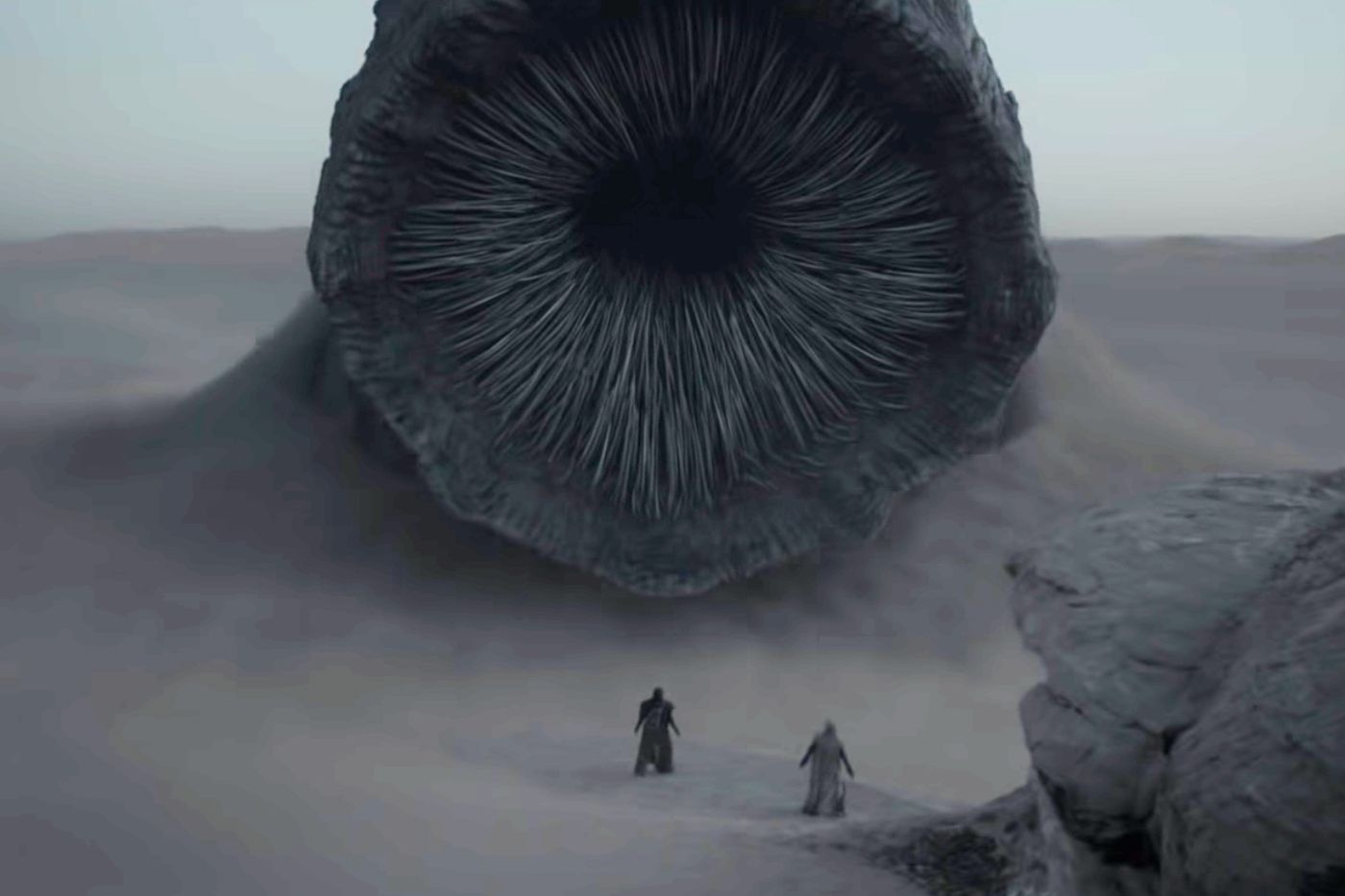
Like it or not, Dune has arrived, and with it a giant worm shaped like, well … We knew it was coming thanks to a particularly striking shot at the end of the trailer, but what we did not know was why. Is it because the worms’ poop is made into money and/or drugs? Is it so that we could hear Oscar Isaac say “butthole” in pressers? If it isn’t clear, I have not seen Dune, but these questions have weighed heavily on my mind since I first laid eyes on the worm, and I trust they will remain even after I see it.
In an attempt to better wrap my head around this orifice-shaped mythical creature, I spoke with Tristan Myles, Dune’s VFX supervisor and the man responsible for bringing the sandworms to life. “I don’t know how you’d be able to avoid that analogy,” Myles confessed when I not so delicately asked him about the worm’s likeness. “It’s a gaping hole, so it’s gonna attract those comparisons.”
What are the worms?Turns out the sandworms of Dune are pretty gross to begin with, so it makes some sense that someone envisioned them as giant buttholes. Sandworms are enormous creatures that live under the space desert where Dune takes place. When they hear rhythmic vibrations on the surface, they come up and suck in anything that happens to be lingering around, including humans. And again, money is made from their poop, I think???
Who invented the worms?Dune, as you may already have been told by a sci-fi bro, is based on a notoriously complex series of books by Frank Herbert. According to Wikipedia, Herbert’s sandworms were inspired by treasure-guarding dragons in European mythology. Shrek made its dragon sexy, which makes me wish Dune had made its sandworms more sexy, but moving on. Here is Herbert discussing his sand-bound monstrosity:
The elements of any mythology must grow from something profoundly moving, something which threatens to overwhelm any consciousness which tries to confront the primal mystery. Yet, after the primal confrontation, the roots of this threat must appear as familiar and necessary as your own flesh. For this, I give you the sandworms of Dune.
I suppose, in a way, the movie has indeed executed his vision: This butthole-shaped worm does threaten to overwhelm my consciousness.
Have the worms always looked like this?Absolutely not. The artwork for the books, which was done by illustrator John Schoenherr, shows the worms with three triangular lobes as their mouths. Behold:

Gross, but less gross than the butthole worm. Herbert was extremely into Schoenherr’s interpretation of his “primal mystery” — so much so that he once said Schoenherr was “the only man who has ever visited Dune.” I wonder how Denis Villeneuve feels about that?
Just kidding. Another man who’s never visited Dune is David Lynch, whose 1984 adaptation of Dune imagined the worm like so:
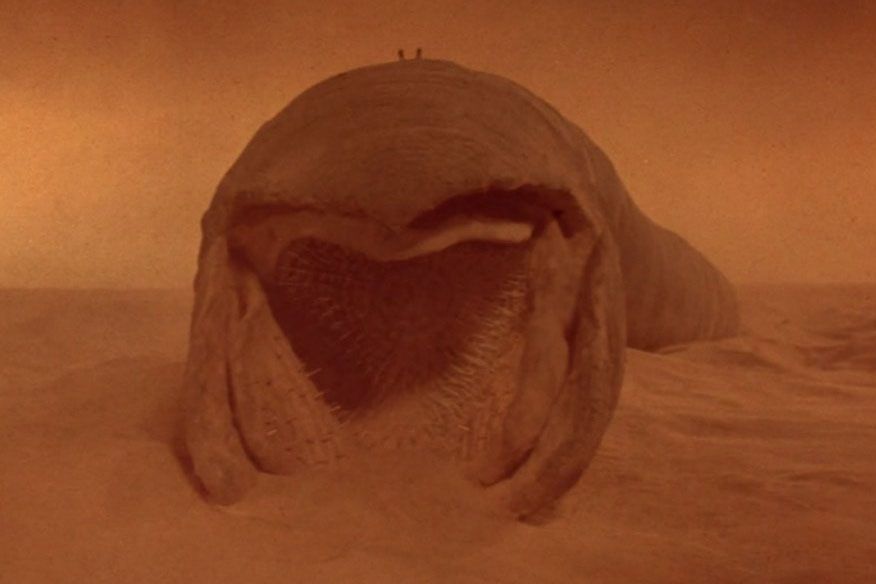
Still not so anal, though I can see it inching toward that territory.
So why does the new Dune worm look like this?When I spoke with Myles, he said he received the worm designs straight from Villeneuve himself, who apparently was very fixated on this particular shape. So we can presume this was exactly how Villeneuve wanted his enormous invertebrate to look. “Denis wanted it to feel like a prehistoric creature,” Myles says, “something from way back in time.”
In order to get to the bottom (sorry) of this, I asked Myles to break things down piece by piece. First there are the worm’s teeth, which are those long filaments reaching toward the center. Those, he told me, are modeled off the teeth of baleen whales, which are bendy so they can sift through water to pull out tiny krill — much like how the worm sifts through sand for its food. Those whales’ mouths certainly don’t look like buttholes, but I think we’re getting somewhere. Because they can bend, the worm’s teeth are curving inward in the shot, which I suspect contributes to the holey appearance.
Second is another unfortunate piece of this perverse puzzle — the outer circle of the worm’s mouth, which is … wrinkly. Myles compares the worm’s skin design to an elephant hide, which is “very thick but still has a bit of movement to it.”
When I ask him point blank about the likeness, Myles points out that the sandworm’s design “is kinda based on nature, and you do see things like that in nature,” by which he presumably means buttholes. And yes, animals have buttholes, so the butthole shape is certainly a natural form.
So there’s your answer! Much like a snowflake, we see this archetypal form over and over again in living things large and small, including in the mouths of gross mythical worms. I feel great about this. Happy Dernflerf Day!
"like this" - Google News
October 23, 2021 at 05:46AM
https://ift.tt/30HiVZp
Why Does the Dune Worm Look Like … That? - The Cut
"like this" - Google News
https://ift.tt/2MWhj4t
Shoes Man Tutorial
Pos News Update
Meme Update
Korean Entertainment News
Japan News Update


No comments:
Post a Comment